

Board Performance · 2025
In this section14 topics
- Prevention of Conflicts of Interest3 items
- Prevention of the Use of Inside Information3 items
- Anti-Corruption6 items
- Whistleblowing3 items
- Selection of Directors & Chief Executives7 items
- Selection of Independent Directors3 items
- Director Development2 items
- Evaluation of Board & Subcommittee Performance2 items
- Subcommittees1 item
- Meeting Attendance & Remuneration3 items
- Supervision of Subsidiaries & Associated Companies5 items
- Board Duty Performance — Overview2 items
- Audit Committee Duty Performance1 item
- Executive Committee Duty Performance1 item
Prevention of Conflicts of Interest
Has the Company Acted to Prevent Conflicts of Interest?
Yes
Operations in the Past Year
Prevention of Conflicts of Interest
The Company has a policy to meticulously resolve conflicts of interest with integrity, reason, and independence under a strong ethical framework, prioritizing the Company's interests. It requires individuals involved or related to a transaction under consideration to disclose information about their interests and those of related parties to the Company, and they must not participate in the consideration or have the authority to approve such transactions. This includes a policy for connected transactions and transactions involving conflicts of interest that comply with laws and regulations of the Office of the Securities and Exchange Commission, the Securities and Exchange Commission, the Capital Market Supervisory Board, and the Stock Exchange.
Policy on the Prevention of Conflicts of Interest
The Company has established a policy on the prevention of conflicts of interest based on the principle that any decision in conducting business activities must be for the utmost benefit of the Company and its shareholders, and actions that may lead to conflicts of interest should be avoided. This means any action where a party involved or having an interest in a transaction benefits or is disadvantaged, whether directly or indirectly, from the Company or its subsidiaries entering into such a transaction. It is stipulated that any party involved or having an interest in the transaction under consideration must inform the Company of their relationship or interest in that transaction and must not participate in the consideration or have the authority to approve such transactions. The policy on the prevention of conflicts of interest has been effective since March 11, 2016.
Company Policy on Connected Transactions
In conducting connected transactions between the Company and its subsidiaries, to establish standards for the operations of the Company and its subsidiaries, the Company deems it appropriate to consider that such connected transactions between the Company and its subsidiaries shall comply with the principles of the Securities and Exchange Act, with details as follows:
The Company and its subsidiaries shall enter into connected transactions or related party transactions in accordance with the criteria of the Securities and Exchange Act and the Capital Market Supervisory Board Notification No. TorJor 21/2551 Re: Rules on Connected Transactions, together with the Stock Exchange of Thailand Notification Re: Disclosure of Information and Operations of Listed Companies in Connected Transactions, as well as various regulations of the Office of the Securities and Exchange Commission and the Stock Exchange of Thailand, and compliance with the requirements for disclosing intercompany transactions in the notes to the financial statements audited by the Company's auditor and the annual registration statement/annual report (56-1 One Report).
In cases where the law requires the Company to obtain approval from the Board of Directors meeting or the shareholders' meeting before entering into any connected transaction, the Company will arrange for the Audit Committee to provide an opinion on such transaction. The Audit Committee's opinion will then be presented to the Board of Directors meeting or the shareholders' meeting, as the case may be, to ensure that the proposed transaction is for the utmost benefit of the Company.
In cases where connected transactions between the Company and its subsidiaries involve individuals who may have a conflict of interest, an interest, or a potential future conflict of interest, the Audit Committee shall provide an opinion on the necessity of entering into such transactions and the appropriateness of their pricing. This will be based on various conditions consistent with normal business practices in the industry and compared with third-party prices or market prices. If the Audit Committee lacks expertise in considering potential connected transactions, the Company will arrange for an independent expert or the Company's auditor to provide an opinion on such transactions, to be used by the Board of Directors, the Audit Committee, or shareholders, as the case may be, for decision-making. Directors with a conflict of interest shall not have the right to vote on such transactions. Furthermore, connected transactions will be disclosed in the notes to the financial statements audited or reviewed by the Company's auditor.
In principle, management may approve such transactions if they involve commercial terms similar to those that a reasonable person would enter into with general counterparties, with commercial bargaining power similar to that which a reasonable person would exercise with general counterparties, free from the influence of their status as a director, executive, or related person. The Company must prepare a summary report of such transactions for presentation at the next Board of Directors meeting.
In 2025, the Company entered into connected transactions, which complied with the criteria of the connected transaction policy and the regulations set forth by the SEC and the Stock Exchange. The Company's policy on entering into connected transactions has been effective since March 11, 2016.
Operations regarding the prevention of conflicts of interest in the past year
The Board of Directors oversees the use of inside information in compliance with laws and good corporate governance principles, having established a written policy on the use of inside information to prevent its misuse for trading the Company's securities or seeking undue benefits. The key points are summarized as follows:
1. Directors, executives, and employees who possess inside information of the Company are prohibited from trading the Company's securities for at least 1 month prior to public disclosure and at least 24 hours after public disclosure before they can conduct the aforementioned transactions. Furthermore, they are prohibited from disclosing such material information to any other person by any means. In the past year 2025, no directors, executives, or relevant employees were found to have traded securities during the period designated by the Company for trading prohibition, thus complying correctly with the policy.
2. The Company Secretary's Office has established and communicated the blackout period for trading or transferring the Company's securities. This involves preparing a notification letter for directors, executives, employees, and related persons to sign acknowledging receipt, and sending reminders via email to request cooperation in adhering to this policy. The Company stipulates that trading or transferring the Company's securities must be suspended at least 1 month prior to the reporting of operating results to the Stock Exchange of Thailand each quarter, to prevent the use of inside information and promote good corporate governance.
Prevention of Conflicts of Interest
The Company is committed to conducting business with due regard for the interests of the Group and all stakeholders, stipulating that it is the duty of all directors, executives, employees, and related parties to avoid involvement in any operations that may lead to conflicts of interest. Furthermore, in cases where it is necessary to enter into transactions involving conflicts of interest, directors, executives, or responsible departments must oversee such transactions to ensure transparency and clarity for the utmost benefit of the Group. Any transaction classified as a connected transaction under the SEC's notification must be strictly compliant with the rules and procedures set forth in the SEC's and the Stock Exchange's notifications. In 2025, the Company monitored compliance with the guidelines on conflicts of interest as stipulated in the business ethics, as follows:
-
The Human Resources Department ensures that new executives and employees study the Group's good corporate governance policies and practices, which are part of the employee regulations published on the website or intranet accessible to all personnel. 100% of all Group personnel and new hires in the fiscal year 2025 have signed an acknowledgment and agreed to comply with the good corporate governance policies and practices, including those concerning conflicts of interest.
-
The Human Resources Department has developed e-learning materials and quizzes on the guidelines for conflicts of interest to enable directors, executives, and employees to review their understanding of important practices that must be adhered to. The training content explains and presents examples of situations, actions, or relationships that constitute a conflict of interest or may lead to a conflict of interest between the personal interests of directors, executives, and employees and the interests of the Group, as well as practices that should be followed when a conflict of interest arises in each case, and informs directors, executives, and employees of their duty to disclose their own and related parties' interests.
to the Company Secretary or Internal Audit Department in accordance with the Group's practices. 100% of the Group's directors, executives, and employees have reviewed the policy and guidelines on conflicts of interest through the aforementioned learning materials.
Number of Conflict-of-Interest Cases
| Metric | Current Year | Previous Year | Two Years Ago |
|---|---|---|---|
| Total number of cases or issues related to conflicts of interest (cases) | 0 | 0 | 0 |
Prevention of the Use of Inside Information
Has the Company Acted to Prevent the Use of Inside Information?
Yes
Operations in the Past Year
Company's Insider Trading Policy
The company places importance on preventing the use of inside information of the company and its subsidiaries. The company aims to have a policy prohibiting directors, executives, employees, and staff from disclosing or seeking benefits for themselves or others, directly or indirectly, from confidential and/or non-public inside information of the company, regardless of whether they receive compensation. This also includes refraining from trading the company's securities using inside information. The Board of Directors' Meeting No. 2/2559 (after transformation) on June 28, 2559, established the following guidelines for preventing the use of inside information:
-
Educate the company's directors and executives regarding their duty to report their own, their spouses', and their minor children's securities holdings to the Securities and Exchange Commission (SEC) in accordance with Section 59 and the penalties stipulated in Section 275 of the Securities and Exchange Act B.E. 2535 (including any amendments), as well as the reporting of the acquisition or disposal of securities by themselves, their spouses, and their minor children to the Securities and Exchange Commission (SEC) in accordance with Section 246 and the penalties stipulated in Section 298 of the Securities and Exchange Act B.E. 2535 (including any amendments).
-
Requires directors and executives of the company, as well as their spouses and minor children, to prepare and disclose reports on their securities holdings and reports on changes in the company's securities holdings to the Securities and Exchange Commission (SEC) in accordance with Section 59 and the penalties stipulated in Section 275 of the Securities and Exchange Act B.E. 2535 (including any amendments), and to submit a copy of this report to the Company Secretary on the same day the report is submitted to the Securities and Exchange Commission.
-
Stipulates that directors, executives, employees, and staff of the company and its subsidiaries who have access to material inside information that has or may have an impact on the change in securities prices must refrain from trading the company's securities during the 30-day period before the financial statements or such inside information is disclosed to the public, and during the 24-hour period after such company information has been disclosed to the public. Furthermore, those involved with such information must not disclose it to others until it has been reported to the Stock Exchange of Thailand. In the event of any violation of the aforementioned regulations, the company will consider it a disciplinary offense under the company's employment regulations and will impose appropriate penalties, ranging from verbal warnings, written warnings, probation, to termination of employment.
In 2025, directors and executives complied with the SEC's notification regarding the reporting of changes in securities holdings after trading securities to the SEC. The company's insider trading policy has been effective since March 11, 2559.
For the fiscal year 2025, the company found no violations or received any tips or complaints regarding the use of inside information that clearly contravened the criteria of regulatory bodies and the good corporate governance principles of the group, and it was not found that directors and executives of the group traded company shares during the prohibited period set by the company.
Number of Inside-Information Cases
| Metric | Current Year | Previous Year | Two Years Ago |
|---|---|---|---|
| Total number of cases or issues related to the use of inside information to seek benefits (cases) | 0 | 0 | 0 |
Anti-Corruption
Introduction
The Company is committed to transparency, ethics, and operating under the principles of good corporate governance, by complying with laws related to the prevention and suppression of corruption, and the giving or receiving of bribes to or from government officials or private sector entities. The Company has established an organizational structure that clearly defines responsibilities, work processes, and lines of command within each department to ensure appropriate checks and balances and rigorous internal oversight.
Operations — Introduction
The Company, by a resolution of the Board of Directors, announced its intention to join the Collective Action Coalition of the Thai private sector against corruption (Thailand's Private Sector Collective Action Coalition Against Corruption: CAC). Its participation was approved on October 8, 2017. The Company proceeded with the project's certification process and submitted supporting documents regarding its business operation policies, operational procedures, and internal control systems. The Collective Action Coalition Committee resolved to certify the Company as a member of the Thai Private Sector Collective Action Coalition Against Corruption on February 4, 2019. The said certificate is valid for 3 years from the date of the resolution for certification. The Company has incorporated this intention into the Code of Conduct for directors, executives, and employees, as well as the guidelines for good corporate governance of the Company. As of December 30, 2021, the Company successfully renewed its certification for the first time. In 2025, the anti-corruption certification was renewed for the second time. The anti-corruption operations during the past year have been conducted in accordance with the Code of Conduct for directors, executives, and employees, as well as the Company's good corporate governance guidelines.
Has the Company Acted on Anti-Corruption?
Yes
Operations in the Past Year
The company requires all its personnel to acknowledge, understand, and comply with the anti-corruption policy and the following good practices:
Anti-Corruption Policy
The company and its subsidiaries prioritize anti-corruption and anti-bribery for business benefits. The Board of Directors meeting resolved to approve the company's signing of the declaration of intent for the Collective Action Coalition of Thai Private Sector Against Corruption. The company and its subsidiaries have incorporated this declaration into the code of conduct for directors, executives, and employees, as well as the guidelines for good corporate governance of the company and its subsidiaries. The company and its subsidiaries publish the anti-corruption policy, including manuals and guidelines, on the company's website to communicate to all company personnel that they must acknowledge, understand, and comply with the anti-corruption policy and the following good practices:
Anti-Corruption Policy
All directors, executives, and employees of the company are prohibited from accepting any form of corruption, directly or indirectly, including receiving items, gifts, hospitality, solicitations, donations, giving or receiving bribes, giving or receiving political support, conflicts of interest, facilitation payments, hiring government employees and officials, and any other benefits, for themselves and company personnel. This applies to employees, business partners, customers, and all stakeholder groups, both domestic and international. The anti-corruption policy shall be reviewed at least once a year.
Definitions
Corruption Refers to bribery in any form, by offering, promising, giving, demanding, or accepting (in monetary/asset form) or any other inappropriate benefit to government officials, government agencies, private entities, business partners, customers, and all stakeholder groups, whether directly or indirectly, or any conduct that suggests corruption in any form, to induce such persons to act or refrain from acting in a manner that secures or maintains business or introduces business to the company specifically, or to obtain or maintain any other inappropriate business benefit, unless permitted by law, regulations, announcements, bylaws, local customs, or trade practices.
Bribery
Giving and Receiving Gifts, Hospitality, and Reception Services (Gift and Hospitality) Refers to giving gifts, hospitality, reception services, or covering travel or other expenses for entertaining clients, business partners, business associates, or other organizations, which does not affect the company's performance but complies with relevant laws. Such acts are given on behalf of the company, not individual employees, and are appropriate for occasions such as New Year, Songkran, Chinese New Year, etc., which are considered normal customs and are conducted openly. This also includes acceptance due to unavoidable necessity, or to maintain good business relationships, or for any other reason.
Giving and Receiving Monetary and Non-Monetary Support (Sponsorship) Refers to the company providing or requesting monetary and non-monetary support (e.g., items, gift vouchers, etc.) for branding purposes, enhancing the company's reputation, and strengthening business relationships. Such support must be transparent, lawful, and not used for corruption.
Donations Refers to the donation of money, items, or any other benefits to any established individual or legal entity, such as associations, foundations, public organizations, temples, hospitals, educational institutions, or organizations that benefit society, with the objective of providing public benefit to society without expecting returns or benefits from the supporting organization.
Accepting Donations Refers to receiving in the form of cash, goods, or assets to be donated to charitable organizations.
Political Assistance (Political Contributions) Refers to giving or offering valuable items such as money, goods, or other benefits to politicians, political parties, or individuals, as well as political activities, whether directly or indirectly.
Conflict of Interest Refers to a situation or action where a director, executive, or employee experiences a conflict between personal interests and the company's interests, affecting decision-making or the impartial performance of duties in their responsible position. This can take various forms, even becoming common practice without being perceived as wrongdoing, such as working for another organization that conflicts with the current one, or conflicts of interest arising from changing workplaces.
Facilitation Payments Refers to small payments made informally to government officials, solely to ensure that government officials follow procedures or to expedite processes, where such procedures do not require the discretion of the government official and are part of the official's duty, including rights that a legal entity is already entitled to by law.
Hiring Government Employees/Officials (Revolving Door) Refers to individuals from the public sector, or former government officials/politicians/consultants of government agencies, working in the private sector, or individuals from the private sector working on policy in the public sector, who may use relationships or inside information to benefit private companies or create conflicts of interest in the performance of duties, leading to corruption risks in terms of personal conflicts of interest for individuals with roles in both organizations, thereby causing government officials to regulate impartially or private sector personnel to attempt to push government policies that benefit their own organizations.
Anti-Corruption Operational Guidelines
Company directors, executives, employees at all levels, and related parties must strictly comply with the anti-corruption policy and business ethics. They must not be involved in corruption, whether directly or indirectly. The following operational guidelines are established:
-
The company must stipulate that anti-corruption measures are an integral part of business operations and are the responsibility of the company's Board of Directors, executives, supervisors, and all employees at every level. They shall have the opportunity to express opinions regarding practices to ensure that anti-corruption operations achieve the established policies appropriately, as well as review operational guidelines and requirements to align with business changes, regulations, and legal requirements in Thailand by:
-
Conduct quarterly corruption risk assessments for the company and verify compliance with risk prevention measures in accordance with internal control systems.
-
Provide orientation and training to personnel to impart knowledge and understanding of policies, measures, and operational procedures for anti-corruption.
-
Establish internal control systems to ensure the efficiency and effectiveness of the anti-corruption policy.
corruption, which covers financial and accounting data recording processes, human resource management, and other processes related to the company's operations. -
Establish reporting, monitoring, and review processes regarding compliance with the anti-corruption policy, with appropriate operational steps to ensure that the policy is comprehensive, sufficient, and up-to-date with current circumstances.
-
Provide secure communication channels for company personnel and all stakeholders to seek advice, report tips, provide suggestions, or file complaints regarding corruption, with measures to protect the rights of such individuals.
-
Establish communication of the anti-corruption policy both internally and externally to the company to ensure widespread compliance, including business representatives, to implement the company's anti-corruption policy.
All directors, executives, and employees must prioritize collective benefits over personal interests and must perform their duties solely for the benefit of the company to prevent conflicts of interest. They must perform their duties with transparency, which includes being prepared for audits of their performance by the company or relevant agencies at all times. Payments or provision of valuable items or services, such as gifts, entertainment, or travel, to government officials, foreign governments, and related parties, whether directly or indirectly, to induce such persons to act or refrain from acting in any manner that is illegal, is highly inappropriate. This also includes not encouraging or participating in such actions by others. Procurement must follow the company's established procedures, be transparent, and auditable. Expenses for business hospitality and other expenses related to the performance of business contracts are permissible according to established procedures, but must be reasonable and auditable.
To ensure that anti-corruption measures are implemented throughout the organization, the company must establish adequate supporting processes to prevent corruption, including processes for auditing sales and marketing, procurement, human resource management, finance, and accounting, etc. Internal operational procedures must include effective internal controls covering corruption prevention.
Anti-Corruption Operational Procedures

Anti-Corruption Operational Procedures
To prevent potential corruption risks to the company, directors, executives, and employees of the company must comply with the following policies:
-
Any actions taken under the anti-corruption policy shall follow the guidelines stipulated in the Corporate Governance and Business Ethics Handbook, policies and guidelines for all stakeholder groups, relevant regulations, operational manuals, and any other guidelines that the company may establish in the future.
-
This anti-corruption policy covers all activities related to the company's operations.
-
Mandate quarterly risk assessments across the organization for potential corruption.
-
To ensure clarity in addressing corruption risks, directors, executives, and employees at all levels of the company must exercise due diligence in the following matters:
Receiving Gifts or Other Benefits (Gift and Hospitality)
Directors, executives, and employees at all levels shall not solicit/demand or accept gifts, hospitality, reception services, or any other benefits, whether financial or any awards, from business partners, creditors, or stakeholders doing business with the company. Unless This refers to acceptance on occasions, customs, or traditional festivals where people customarily exchange items. The value of such items or other benefits received must not exceed 3,000 Baht per person per occasion.
In cases where gifts or other benefits exceed the specified value and/or it is necessary to accept gifts or other benefits to maintain good relationships between individuals or organizations, senior management (Department Director/Manager) or their assigned delegate shall act as the organization's representative in accepting such items or benefits.
The Human Resources Department is responsible for receiving and storing gifts in a designated locked cabinet. The Deputy Manager of the Human Resources Department shall hold the key to this cabinet. After receiving gifts or other benefits, they must be submitted to the Human Resources Department for storage within 5 days, and the details and quantity of gifts or other benefits received must be recorded, with the signature of the deliverer, in the gift control register maintained by the Human Resources Department.
For customary seasonal souvenirs, the company permits employees to accept them, provided their value does not exceed 3,000 Baht per person per occasion, such as calendars, keychains, notebooks, etc., bearing the organization's logo.
Giving Gifts
Gift-giving is permitted on traditional festive occasions where people customarily exchange gifts. The company will procure such gifts, with a specified price or value not exceeding 3,000 Baht per person per occasion.
In cases where gifts exceed the specified value and/or it is necessary to accept gifts or other benefits to maintain good relationships between individuals or organizations, the relevant department must specify the purpose in the expense reimbursement documents for procuring/acquiring gifts, such as a purchase requisition or payment form, etc. This must be submitted to the authorized approver according to operational and approval authority regulations.
For gifts prepared for festivals or occasions with a defined survey cycle, such as New Year, Songkran, Chinese New Year, etc., the Human Resources Department is responsible for storing gifts in a designated locked cabinet. The Deputy Manager of the Human Resources Department shall hold the key to this cabinet. The department requesting gifts, based on the surveyed quantity, shall withdraw them from the Human Resources Department and record the quantity withdrawn, with the signature of the withdrawer, in the gift control register maintained by the Human Resources Department.
The Human Resources Department, or the Administration Department (Admin), or an assigned unit shall survey the number of gifts in each department and prepare an internal memo to request approval for the procurement/acquisition of gifts from the Chief Executive Officer (CEO) before proceeding with procurement/acquisition according to the company's established guidelines.
To avoid leading to bribery, the company requires an appropriateness check before proceeding and designates senior management as the organization's representative for giving items or other benefits.
Request for Reimbursement of Hospitality Expenses, Reception Expenses, or Other Expenses for Entertaining Clients, Business Partners, Business Associates, or Other Organizations
Senior executives, department managers, or personnel assigned by senior executives may conduct hospitality or reception for clients, business partners, business associates, or other organizations in accordance with the company's operational authority and business objectives, including maintaining good business relationships, and doing so openly without affecting the company's performance.
After hospitality, the hosting unit shall prepare expense reimbursement documents, specifying important information on the payment form, including the entity/client hosted, amount, date of hospitality, and purpose of hospitality, along with proof of payment such as receipts, substitute receipts, invoices, etc. This must be submitted to the authorized approver according to operational and approval authority regulations, and supporting documents for expense reimbursement must be sent to the Accounting and Finance Department for verification according to the disbursement procedures.
Charitable Donations
Assigned personnel must prepare expense reimbursement documents, specifying important information on the payment form, including the name of the individual/entity receiving the donation, purpose, amount, and date of transaction, along with supporting evidence of the donation request or request for assistance from the company. This must be submitted to the authorized approver according to operational and approval authority regulations, and supporting documents for expense reimbursement must be sent to the Accounting and Finance Department for verification according to the disbursement procedures.
Donations must be conducted correctly, openly, and transparently, without violating moral principles, and in compliance with laws, company regulations, including government agencies, state enterprises, and other relevant bodies. They must align with social, community, and environmental policies or activities that promote the company's sustainable development, or be activities that benefit society, not as an excuse for corruption. There should be no hidden objectives to gain an advantage or create incentives for business favoritism, and no conflict between personal interests and the company's interests should arise.
Accepting Donations The company has no policy to accept donations; rather, the company will be the giver without expecting returns. The company communicates this policy to all employees. Management and supervisors are responsible for overseeing and ensuring that employees in their respective lines strictly adhere to the policy.
Providing Monetary and Non-Monetary Support (Sponsorship)
The company provides monetary and non-monetary support (e.g., items, gift vouchers, etc.) for the purpose of enhancing the company's reputation and strengthening business relationships. Such support must be transparent, lawful, and not used for corruption.
For requests for monetary and non-monetary support, prepare supporting documents for the support request, specifying important information on the payment form, including the name of the entity requesting support, value, purpose of the support, and attach evidence of the support request from the company for decision-making. This is to be submitted to the Chief Executive Officer (CEO) or the approving department director, and supporting documents for reimbursement must be sent to the Accounting and Finance Department for verification according to the disbursement procedures.
Requesters for monetary and non-monetary support must track evidence of receipt of the supported funds/items to ensure that the supported funds/items are fully delivered to the receiving entity, used for the intended purpose, and submit evidence such as photos, emails, etc., to the Accounting and Finance Department for documentation/proof of support.
Receiving Monetary and Non-Monetary Support (Sponsorship)
The company accepts monetary and non-monetary support (e.g., items, gift vouchers, etc.) only on an organization-to-organization basis, for the purpose of enhancing the company's reputation and strengthening business relationships. Such support must be transparent and lawful. The requester must prepare a request for assistance document, specifying the name of the requesting entity, value, purpose of the requested support, and attach important supporting documents for decision-making. This is to be submitted to the authorized person in the reporting line to consider the appropriateness of the details of the monetary/item support received, ensuring it aligns with the company's specified purpose for the support. Monetary/item support received must be in the form of a check or bank transfer to the company's account only. The authorized person in the reporting line is responsible for monitoring that the monetary/item support is actually used for the requested activities according to the stated purpose. The requester must prepare a thank-you letter and submit proof of receipt of support to the Accounting and Finance Department for verification, in order to issue a receipt to the supporter.
Political Aspects
The company conducts its business with political neutrality, refraining from involvement or allegiance to any political party or political authority. It shall not use company funds or resources to support, directly or indirectly, any political entity. The following political guidelines and practices are established:
-
The company respects the personal rights of employees to participate in or support various political activities in their private capacity. Employees must do so outside working hours, without misrepresenting the company's reputation, and without using company assets for such activities.
-
Supervisors at all levels are prohibited from ordering or influencing employees and subordinates in any way that leads them to participate in any type of political activity. They must also avoid expressing political opinions in the workplace or during working hours, which could lead to ideological conflicts.
Transactions with Business Partners, Contractors, Government Agencies, or Entities Doing Business with the Company
-
Bribery or acceptance of bribes in any business dealings with partners, contractors, government agencies, or entities doing business with the company is prohibited. All operations must be transparent and comply with relevant laws.
-
To prevent conflicts of interest, directors, executives, employees, and staff of the company shall not seek personal gain from their work, nor use company opportunities or inside information for their own benefit or that of others. They shall maintain trade secrets and not engage in businesses that compete with or are similar to the company's, to ensure that no conflicts of interest arise.
-
Procurement must clearly state its objectives, involve transparent and fair price comparisons from vendors/service providers for all parties, and be submitted to the direct supervisor for consideration of appropriateness. Approval must be in accordance with the company's operational authority.
-
Personnel in procurement, sales, and marketing (domestic) shall send a letter notifying business partners, both buyers and sellers, of the communication policy for the Collective Action Coalition Against Corruption (CAC) project for acknowledgment and signature. They shall also monitor responses from business partners and prepare an annual summary report of the number of business partners notified of the measures and the number of responses received, to summarize the results of these operations.
Facilitation Payments
The company has no policy to pay facilitation payments in any form, whether direct or indirect. It will not undertake any actions or accept any acts in exchange for business facilitation, referencing the Act on Facilitation in Consideration of Permits by Government Agencies.
Hiring Government Employees/Officials
-
The company has no policy to hire or appoint currently serving government officials to work within the company.
-
Establish a cooling-off period of 2 years for the appointment of former government officials who have left their positions, or individuals who previously worked for regulatory agencies directly related to the company.
-
Prohibitions on duties and practices should be specified to prevent abuse of power or issues involving conflicts of interest, such as disclosing secrets of a former government agency, lobbying for undue benefits, or being assigned to contact a former agency, etc.
-
Increase transparency in appointments by disclosing the names and backgrounds of former government officials appointed as consultants/directors/executives of the company, along with the reasons for their appointments in the company's public documents.
Preparation of Financial Reports
-
Ensure transparent and correct processes, as well as establish appropriate and effective internal control systems to prevent improper practices.
-
All accounting entries must have appropriate and accurate details, clearly specifying expenditures, sales, asset management, and transaction purposes. There must be no falsification of accounting records and related documents to conceal actual transactions.
-
Implement a process for verifying accounting entries or information in information systems across multiple units, creating checks and balances and preventing improper practices.
Personnel Recruitment Process Promotions, training, and performance evaluations that reflect the company's commitment to anti-corruption measures, as follows:
-
Personnel Recruitment
1.1) Conduct criminal background checks or reference checks to initially ensure that individuals considered for employment by the company possess good conduct and attitude before proceeding with the signing of an employment contract.
1.2) Conduct exit interviews with employees, covering concerns about corruption within the company that employees may have observed during their employment.
Training
The Human Resources Department shall establish communication guidelines and channels to raise awareness among company personnel by supporting and promoting knowledge about the anti-corruption policy, as well as practices related to anti-corruption, including ethics, to foster honesty and integrity. This is to convey the company's commitment that corruption is wrong and unacceptable, and to instill it as part of the organizational culture.
Performance Evaluation
-
Performance evaluation principles must be appropriate and fair according to human resource management policy, stipulating that ethics and anti-corruption are among the key performance indicators for employee evaluation.
-
Do not demote, punish, or impose negative consequences on employees who refuse corruption, even if such refusal results in the company losing business opportunities.
Conflict of Interest
-
Directors, executives, and employees shall avoid related-party transactions that may create conflicts of interest with the company. The performance of duties and holding of positions must not conflict with the company's interests. Decisions regarding the company's business operations must be made for the company's best interests.
-
All actions and decisions by directors, executives, and employees at every level must be free from the influence of personal desires or those of individuals related to such directors, executives, and employees, whether by family or others. Fair and appropriate prices must be used, as if transacting with external parties. When deciding on or approving items that may involve conflicts of interest, the matter must be reported to the supervisor or co-approver, and the individual must recuse themselves from involvement in such items.
-
All directors, executives, and employees should disclose any business or personal ventures, or those conducted with family, relatives, dependents, or through others, that may create a business conflict of interest with the company or its affiliates.
-
Directors, executives, and employees are required to immediately report to the company their interests and/or those of related persons that constitute interests related to the company's management, as well as report their direct or indirect holdings of company securities. Furthermore, they have a duty to comply with the regulations of the Stock Exchange and the Securities and Exchange Commission regarding the disclosure of connected transactions.
Directors, executives, and employees shall not seek personal gain for themselves or others by utilizing confidential information of the company or its affiliates, such as business plans, revenues, financial reports, meeting resolutions, business forecasts, research results, or bidding prices, for personal benefit, regardless of whether it causes damage to the company.
Preparation of Financial Reports Ensure transparent and correct processes, as well as establish appropriate and effective internal control systems to prevent improper practices.
-
All accounting entries must have appropriate and accurate details, clearly specifying expenditures, sales, asset management, and transaction purposes. There must be no falsification of accounting records and related documents to conceal actual transactions.
-
Implement a process for verifying accounting entries or information in information systems across multiple units, creating checks and balances and preventing improper practices.
Internal Communication
-
Ensure employees are aware of the anti-corruption policy and guidelines through training, public notices, distribution, and storage in the company's database system.
-
Require directors, executives, and employees to sign a written acknowledgment of their commitment to implement the anti-corruption policy.
External Communication
-
Prepare the anti-corruption policy and guidelines document as an appendix to contracts between the company and individuals acting on behalf of the company, consultants, brokers, contractors, and business partners.
-
Published on the company's website.
Requesting Advice The company provides secure and accessible channels for employees and other individuals to seek advice regarding compliance with the anti-corruption policy and to report misconduct or complaints, ensuring that informants are adequately protected. A person is designated to investigate and follow up on all reported matters as follows:
-
If anyone has questions or requires advice regarding compliance with the anti-corruption policy, directors, executives, employees, and related parties may proceed as follows:
1.1) Consult with the Company Secretary.
-
Telephone: 022108888
-
Send an email to the Company Secretary at Email: ir@tnrcondom.com
-
Send a letter by mail to: Company Secretary, 1 Charoenrat Road, Thung Wat Don, Sathon, Bangkok 10120.
-
Submit a letter in the suggestion box.
1.2) Individuals seeking advice may choose to remain anonymous. However, providing the name of the advice-seeker will enable direct and prompt communication of advice back to them, to help directors, executives, and employees understand the guidelines for complying with the anti-corruption policy.
Reporting Misconduct or Complaints Upon observing any suspected violation or non-compliance with the anti-corruption policy and measures, directors, executives, employees, and relevant parties have a duty to report such information through the following communication channels:
Send an email to the Chairman of the Audit Committee.
Send a letter by mail to: Chairman of the Audit Committee, Thai Nippon Rubber Industry Public Company Limited, 1 Charoenrat Road, Thung Wat Don, Sathon, Bangkok 10120, Suggestion, Comment, and Complaint Box within the company.
-
In cases requiring urgent reporting of identified issues, directors, executives, employees, and relevant parties have a duty to inform senior management or the Board of Directors through the aforementioned communication channels.
-
The company has publicized these complaint channels to employees through training and internal communication channels. Furthermore, these channels have also been made known to external stakeholders via the company's website.
Handling of Reported Tips or Complaints The Company Secretary will be responsible for collecting documents received through the aforementioned channels to summarize all suggestions and issues, which will then be submitted to the Board of Directors for consideration and action. The company has criteria for establishing an investigation committee to ensure a fair process for investigation and imposing penalties on offenders. However, if there is clear and sufficient evidence that the whistleblower or complainant reported the matter with malicious intent, they may be subject to penalties depending on the case, as follows:
-
If an employee, they will be investigated and disciplined according to the company's employment regulations.
-
If the individual is an external party and causes damage to the company, the company may consider legal action against the whistleblower or complainant.
As of 2025, there have been no complaints regarding corruption or other complaints.
Protection and Confidentiality Measures
-
To protect the rights of complainants or informants acting in good faith, the company will conceal the name, address, or any information that could identify the complainant or informant, and keep their information confidential, limiting access only to those responsible for investigating the complaint, to the extent necessary to access such information.
-
In cases of complaints involving corruption by a company director, audit committee member, or Chief Executive Officer, the Board of Directors shall appoint an independent intermediary. Directors involved in the complaint shall not have the right to access information and the intermediary shall protect whistleblowers, complainants, witnesses, and individuals providing information for the investigation from any harm or danger arising from reporting, testifying, or providing information. Complainants are requested to submit their complaints directly to a company director not involved in the matter.
-
The company has a policy not to demote, punish, or impose negative consequences on employees who refuse corruption, even if such refusal results in the company losing business opportunities.
Investigation Procedures
-
Upon receiving a tip, the Audit Committee will screen and investigate the facts.
-
During the factual investigation, the Audit Committee may assign a representative to periodically inform the whistleblower or complainant of the progress.
-
If the factual investigation reveals that the available information and evidence provide reasonable grounds to believe that the accused has indeed committed corruption, the company will grant the accused the right to be informed of the allegations and the right to prove their innocence by seeking additional information or evidence to demonstrate their non-involvement in the alleged corrupt act.
If the accused is found to have committed corruption, such corruption is considered a violation of the anti-corruption policy and the company's business ethics. The offender will be subject to disciplinary action as stipulated in the company's regulations. If the corrupt act is also illegal, the offender may face legal penalties. The investigation period is set to be completed within 7 days from the date the issue is identified.
Penalties
-
The anti-corruption policy and measures are considered part of the operational discipline for company directors, executives, and employees at all levels, and are part of compliance with Thai law. In cases where the offender is an employee, they will be investigated and subject to disciplinary action, including termination of employment without severance pay. However, if the offender is a company director and/or executive, they will be subject to disciplinary investigation, removal from their position, and legal prosecution.
Enforcement
-
This anti-corruption policy is effective for directors, executives, employees, and related parties, including those working for the company, from the date the Board of Directors signed and approved the anti-corruption policy.
-
Any improvements, amendments, changes, or cancellations must be approved by the Board of Directors every time.
-
In cases where relevant parties or stakeholders wish for the company to improve, amend, change, or review the anti-corruption measures stipulated in the anti-corruption policy, a written document must be prepared and submitted through the designated channels (as per the section "Reporting Misconduct or Complaints").
Form of Anti-Corruption Operations
| Operation |
|---|
| Review of appropriateness in anti-corruption |
| The participation in anti-corruption projects |
| Assessment and identification of corruption risk |
| Communication and training for employees on anti-corruption policy and guidelines |
| The monitoring of the evaluation of compliance with the anti- corruption policy |
| Review of the completeness and adequacy of the process by the Audit Committee or auditor |
Number of Corruption Cases
| Metric | Current Year | Previous Year | Two Years Ago |
|---|---|---|---|
| Total number of cases or issues related to corruption (cases) | 0 | 0 | 0 |
Whistleblowing
Has the Company Implemented Whistleblowing Procedures?
Yes
Operations in the Past Year
Reporting misconduct or complaints when observing actions suspected of violating or not complying with anti-corruption policies and measures. Directors, executives, employees, and relevant parties are obliged to report such information through the following communication channels:
-
Send an email to the Chairman of the Audit Committee.
-
Send a letter by post to: Chairman of the Audit Committee, Thai Nippon Rubber Industry Public Company Limited, 1 Charoenrat Road, Thung Wat Don Subdistrict, Sathon District, Bangkok 10120. Suggestion, comment, and complaint box within the company.
-
In cases where issues need to be reported urgently, directors, executives, employees, and relevant parties are obliged to inform senior management or the Board of Directors through the aforementioned communication channels.
-
The Company has publicized these complaint channels to employees, informing them of training channels and internal communication channels, and has also disseminated these channels to external stakeholders through the Company's website.
-

Management of reported or complained matters
-
The Company Secretary shall be responsible for collecting documents received through such channels to summarize all suggestions and issues, which will then be presented to the Board of Directors for consideration and action. The Company also has criteria for establishing an investigation committee to ensure a fair process in considering investigations and imposing penalties on offenders. However, if there is clear and sufficient evidence that the whistleblower or complainant reported the matter with dishonest intent, they may be subject to penalties depending on each case, as follows:
-
If the person is an employee, an investigation will be conducted to consider disciplinary action in accordance with the Company's employment regulations.
-
If the person is an external party and causes damage to the Company, the Company may consider taking legal action against the whistleblower or complainant.
-
In 2025, there were no complaints regarding corruption and other complaints.
Number of Whistleblowing Cases
| Metric | Current Year | Previous Year | Two Years Ago |
|---|---|---|---|
| Total number of cases or issues received through whistleblowing channels (cases) | 0 | 0 | 0 |
Selection of Directors & Chief Executives
Directors & Chief Executives — Introduction
Methods for Recruiting Directors and High-Level Executives
High-level executives
The Board of Directors recruits and develops high-level executives to possess the knowledge, skills, experience, and attributes necessary to drive the organization towards its goals. A Succession Plan has been established for high-level executive positions and other key positions within the Company to ensure the Company has measures in place should the Chief Executive Officer be unable to perform duties, complete their term, or if the CEO position becomes vacant for any other reason. Additionally, it ensures the establishment of a fair and appropriate compensation structure and performance evaluation. This is to mitigate risks or impacts that may arise from a lack of continuity in the Company's management.
High-Level Executive Succession Plan
The Company has developed a succession plan and a high-level executive development plan, especially for the position of Chief Executive Officer (CEO), to ensure business continuity and to strengthen personnel readiness for succession in key positions. The recruitment guidelines are as follows:
1. The Executive Committee and the Chief Executive Officer (CEO) jointly plan the succession for high-level executive positions by defining the skills, knowledge, capabilities, and potential of individuals who will be successors.
2. The Board of Directors has established policies and criteria for the selection of the Chief Executive Officer (CEO) and a succession policy in case of emergencies.
3. Retirement of the Chief Executive Officer (CEO), with a clear and transparent recruitment process, and training and development of the knowledge and capabilities of successors through various methods such as training, special assignments, and job rotation, to enhance necessary skills and prepare executives for succession.
4. The Human Resources Department is responsible for reporting the high-level executive succession plan and the development results according to the individual development plans of suitable executives for succession to the Nomination and Remuneration Committee for consideration at least once a year and upon significant changes.
5. The Nomination and Remuneration Committee proposes suitable candidates to the Board of Directors for appointment as President and Senior Executive Vice President. It also reports progress and summarizes the performance of the high-level executive succession plan to the Board of Directors at least once a year and upon significant changes.
Are Directors Selected Through the Nomination Committee?
Yes
Are Chief Executives Selected Through the Nomination Committee?
Yes
Directors from Major Shareholders — Introduction
A portion of the company's major shareholders consists of shares held by individuals from the Dararattanaroj family, comprising (1) Mr. Amorn Dararattanaroj, (2) Mr. Somsak Dararattanaroj, (3) Miss Sirinun Dararattanaroj, (4) Mr. Surapol Dararattanaroj, and (5) Ms. Benjarat Dararattanaroj.
Number of Directors from Major Shareholders
5
Rights of Minority Shareholders on Director Appointment
This agenda item requires approval by a majority vote of the shareholders present at the meeting and casting their votes, excluding abstentions from the vote count, in accordance with Section 107 of the Public Limited Company Act B.E. 2535 (1992) (including any amendments thereof) and Article 35 of the Company's Articles of Association. Shareholders shall consider electing directors individually, with each shareholder having one vote per share (One share, one vote).
Method of Director Appointment
| Method |
|---|
| Method whereby each director requires approval votes more than half of the votes of attending shareholders with voting rights |
Selection of Independent Directors
Introduction
Qualifications of Independent Directors
Independent directors must possess independence qualifications as prescribed by the Company and in accordance with the guidelines stipulated in the Notification of the Capital Market Supervisory Board, and must be individuals capable of safeguarding the interests of all shareholders equally to prevent conflicts of interest. Furthermore, they must be able to attend Board of Directors' meetings and provide independent opinions.
Criteria for Selecting Independent Directors
Independent directors must possess independence qualifications as defined by the company. The company stipulates that non-executive directors shall be independent from management, major shareholders, and controlling persons, and be a person who has no business relationship with the company that would restrict their ability to demonstrate independence, and must possess additional qualifications as follows:
Hold no more than one percent of the total voting shares of the company, its parent company, subsidiaries, associated companies, major shareholders, and controlling persons of the company. This includes the shareholding of related persons of that independent director.
Not be or have been a director involved in management, an employee, a salaried consultant, or a controlling person of the company, its parent company, subsidiaries, associated companies, fellow subsidiaries, major shareholders, or controlling persons of the company, unless such characteristics have ceased for at least two years prior to appointment. However, this prohibition does not include cases where an independent director was previously a government official or a consultant to a government agency that is a major shareholder or controlling person of the company.
Not be a person having a blood relationship or legal registration as a father, mother, spouse, sibling, or child, including the spouse of a child of another director, executive, major shareholder, controlling person, or a person nominated to be a director, executive, or controlling person of the company or its subsidiaries.
Not have or have had a business relationship with the company, its parent company, subsidiaries, associated companies, major shareholders, or controlling persons of the company in a manner that may impede their independent judgment, and not be or have been a significant shareholder or controlling person of those having a business relationship with the company, its parent company, subsidiaries, associated companies, major shareholders, or controlling persons of the company, unless such characteristics have ceased for at least two years prior to appointment. Such business relationships include normal commercial transactions for business operations, leasing or subleasing of real estate, transactions related to assets or services, or providing or receiving financial assistance through loans, guarantees, pledging assets as collateral for debts, including any other similar circumstances, which result in the company or the counterparty having a debt obligation to another party of three percent or more of the company's net tangible assets or twenty million baht or more, whichever is lower. The calculation of such debt obligations shall be in accordance with the method for calculating the value of connected transactions as per the Capital Market Supervisory Board's announcement on criteria for connected transactions, mutatis mutandis. For the consideration of such debt obligations, debts incurred within one year prior to the date of the business relationship with the same person shall be included.
Not be or have been an auditor of the company, its parent company, subsidiaries, associated companies, major shareholders, or controlling persons of the company, and not be a significant shareholder, controlling person, or partner of an accounting firm to which an auditor of the company, its parent company, subsidiaries, associated companies, major shareholders, or controlling persons of the company belongs, unless such characteristics have ceased for at least two years prior to appointment.
Not be or have been a professional service provider, including legal or financial advisors, who received service fees exceeding two million baht per year from the company, its parent company, subsidiaries, associated companies, major shareholders, or controlling persons of the company, and not be a significant shareholder, controlling person, or partner of such professional service provider, unless such characteristics have ceased for at least two years prior to appointment.
Not be a director appointed as a representative of a director of the company, a major shareholder, or a shareholder related to a major shareholder.
Not be a person engaged in a business of the same nature and in significant competition with the company's business or its subsidiaries, or be a significant partner in a partnership, or be a director involved in management, an employee, a salaried consultant, or hold more than one percent of the total voting shares of a company engaged in a business of the same nature and in significant competition with the company's business or its subsidiaries.
Possess no other characteristics that would prevent them from providing independent opinions on the company's operations.
Director Nomination Process
Directors
The Nomination and Remuneration Committee shall nominate and propose individuals who possess full qualifications as specified in the Board Charter published on the company's website (https://www.tnrcondom.com/th/corporategovernance/charters) to serve as directors of the company. Such individuals will then be presented to the Board of Directors' meeting for submission to the Shareholders' Meeting for election.
The Shareholders' Meeting shall elect directors of the company. However, in the case of electing a director to fill a vacancy for reasons other than the expiration of a term, the Board of Directors may select a person who possesses full qualifications as specified in the Board Charter to serve as a director. Such person appointed as a director in this case shall serve only for the remaining term of the director who vacated the position.
At every Annual General Meeting of Shareholders, one-third of the total number of directors shall retire from office. If the number of directors cannot be divided exactly into three parts, the number closest to one-third shall retire. Retiring directors may be re-elected. For the first and second years after registration, the directors to retire shall be determined by drawing lots. For subsequent years, the director who has been in office the longest shall retire from office.
The Board of Directors plays a crucial role in overseeing the company's management, including setting the company's direction, policies, and business strategies for the utmost benefit of the company and its shareholders, and monitoring the performance of the company's various sub-committees. Furthermore, the Board of Directors also has powers, duties, and responsibilities as stipulated in the laws, regulations, objectives, and resolutions of the company's Shareholders' Meeting.
Composition
The composition of the Board of Directors is as follows:
Directors of the company are not required to be shareholders of the company.
The Board of Directors shall consist of a number determined by the Shareholders' Meeting, but must comprise at least 5 directors, and at least half of the total number of directors must reside in the Kingdom.
The Board of Directors shall consist of at least one-third of the total number of independent directors, but must
at least 3 persons.
The Board of Directors shall elect one director to be the Chairman of the Board. If the Board of Directors deems it appropriate, it may consider electing one or more other directors as Vice Chairman of the Board.
Qualifications of Directors
Directors of the company must possess the following qualifications:
Be a person with knowledge, ability, integrity, business ethics, and sufficient time to dedicate their knowledge and ability and perform duties for the company.
Possess full qualifications and not have any prohibited characteristics under the Public Limited Company Act, the Securities and Exchange Act, and other relevant laws, and must not have characteristics indicating a lack of suitability to be entrusted with managing a public company as prescribed by the Capital Market Supervisory Board.
Not be a person engaged in a business of the same nature and in competition with the company's business, or be a partner or director in another legal entity engaged in a business of the same nature and in competition with the company's business, whether for their own benefit or that of others, unless the Shareholders' Meeting has been informed prior to the resolution of appointment.
Independent directors must possess qualifications regarding independence as defined by the company and in accordance with the guidelines stipulated in the Capital Market Supervisory Board's announcements. They must be individuals capable of equally safeguarding the interests of all shareholders to prevent conflicts of interest. Furthermore, they must be able to attend Board of Directors meetings and provide independent opinions.
The company stipulates that non-executive directors shall be independent from management.
major shareholders, and controlling persons, and be a person who has no business relationship with the company that would restrict their ability to
express independent opinions, and must possess additional qualifications as follows:
(a) Hold no more than one percent of the total voting shares of the company, its parent company, subsidiaries, associated companies, major shareholders, or controlling persons of the company. This includes the shareholding of related persons of that independent director.
(b) Not be or have been a director involved in management, an employee, a salaried consultant, or a controlling person of the company, its parent company, subsidiaries, associated companies, fellow subsidiaries, major shareholders, or controlling persons of the company, unless such characteristics have ceased for at least two years prior to appointment. However, this prohibition does not include cases where an independent director was previously a government official or a consultant to a government agency that is a major shareholder or controlling person of the company.
(c) Not be a person having a blood relationship or legal registration as a father, mother, spouse, sibling, or child, including the spouse of a child of another director, executive, major shareholder, controlling person, or a person nominated to be a director, executive, or controlling person of the company or its subsidiaries.
(d) Not have or have had a business relationship with the company, its parent company, subsidiaries, associated companies, shareholders
major shareholders, or controlling persons of the company in a manner that may impede their independent judgment, and not be or have been a significant shareholder or controlling person of those having a business relationship with the company, its parent company, or subsidiaries.
associated companies, major shareholders, or controlling persons of the company, unless such characteristics have ceased for at least two years prior to appointment.
Such business relationships include normal commercial transactions for business operations, leasing or subleasing of real estate, transactions related to assets or services, or providing or receiving financial assistance through loans, guarantees, pledging assets as collateral for debts, including any other similar circumstances, which result in the company or the counterparty having a debt obligation to another party of three percent or more of the company's net tangible assets or twenty million baht or more, whichever is lower. The calculation of such debt obligations shall be in accordance with the method for calculating the value of connected transactions as per the Capital Market Supervisory Board's announcement on criteria for connected transactions, mutatis mutandis. For the consideration of such debt obligations, debts incurred within one year prior to the date of the business relationship with the same person shall be included.
(e) Not be or have been an auditor of the company, its parent company, subsidiaries, associated companies, major shareholders, or controlling persons of the company, and not be a significant shareholder, controlling person, or partner of an audit firm which has
an auditor of the company, its parent company, subsidiaries, associated companies, major shareholders, or controlling persons of the company belongs, unless such characteristics have ceased for at least two years prior to appointment.
(f) Not be or have been a professional service provider, including legal or financial advisors, who received service fees exceeding two million baht per year from the company, its parent company, subsidiaries, associated companies, major shareholders, or controlling persons of the company, and not be a significant shareholder, controlling person, or partner of such professional service provider, unless such characteristics have ceased for at least two years prior to appointment.
(g) Not be a director appointed as a representative of a director of the company, a major shareholder, or a shareholder related to a major shareholder.
(g) Not be a person engaged in a business of the same nature and in significant competition with the company's business or its subsidiaries, or be a significant partner in a partnership, or be a director involved in management, an employee, a salaried consultant, or hold more than one percent of the total voting shares of another company engaged in a business of the same nature and in significant competition with the company's business or its subsidiaries.
(h) Possess no other characteristics that would prevent them from providing independent opinions on the company's operations.
Election and Term of Office
The Nomination and Remuneration Committee shall nominate and propose individuals who possess full qualifications as specified in item 3 above to serve as directors of the company. Such individuals will then be presented to the Board of Directors' meeting for submission to the Shareholders' Meeting for election.
The Shareholders' Meeting shall elect directors of the company. However, in the case of electing a director to fill a vacancy for reasons other than the expiration of a term, the Board of Directors may select a person who possesses full qualifications as specified in item 3 above to serve as a director. Such person appointed as a director in this case shall serve only for the remaining term of the director who vacated the position.
At every Annual General Meeting of Shareholders, one-third of the total number of directors shall retire from office. If the number of directors cannot be divided exactly into three parts, the number closest to one-third shall retire. Retiring directors may be re-elected. For the first and second years after the company's registration, the directors to retire shall be determined by drawing lots. For subsequent years, the director who has been in office the longest shall be
those who retire from office.
In addition to retirement by rotation, a director may vacate office when
(a) Death
(b) Resignation
(c) Lacks qualifications to be a director of the company or has prohibited characteristics under the Public Limited Company Act or characteristics indicating a lack of suitability to be entrusted with managing a public company as per the Securities and Exchange Act.
(d) A resolution of the Shareholders' Meeting for removal from office.
(e) A court order for removal.
Any director wishing to resign from their position shall submit a letter of resignation to the Chairman of the Board.
Powers, Duties, and Responsibilities
The Board of Directors, as representatives of the shareholders, shall have the following powers, duties, and responsibilities:
Perform duties and oversee the operations of the company and its subsidiaries in accordance with laws, objectives, regulations, resolutions of the Board of Directors' meetings, as well as resolutions of the Shareholders' Meetings, with responsibility, prudence, and integrity to protect the rights and interests of the company and all shareholders, and have the duty to ensure that the company and its subsidiaries comply with various laws related to the business operations of the company and its subsidiaries.
Define the vision, strategies, business direction, policies, objectives, business plans, budgets, management structure, and approval authority of the company and its subsidiaries as proposed by management, including overseeing the management and performance of management or any persons assigned to perform such duties, to ensure compliance with established policies efficiently and effectively to maximize value for the company, its subsidiaries, and shareholders.
Continuously and consistently monitor and evaluate the performance of management to achieve strategies
and in accordance with plans and budgets, including overseeing the executive remuneration mechanism to ensure its appropriateness.Establish frameworks and policies for determining salaries, salary increases, bonuses, remuneration, and incentives for the Chief Executive Officer.
Ensure that the company and its subsidiaries have appropriate and efficient accounting systems, and provide reliable financial reporting and auditing, as well as adequate and appropriate internal control and internal audit systems, and a document retention system that allows for subsequent verification of data accuracy.
Acknowledge the audit report of the Audit Committee.
Consider and approve the acquisition or disposal of assets (in cases where the size of the transaction does not require consideration by the Shareholders' Meeting), investments in new businesses, and any operations in accordance with relevant laws, announcements, and regulations.
Consider and approve connected transactions (in cases where the size of the transaction does not require consideration by the Shareholders' Meeting) of the company and its subsidiaries to be in accordance with relevant laws, announcements, and regulations.
Consider and approve the payment of interim dividends to the company's shareholders.
Consider and establish enterprise-wide risk management policies, and oversee the implementation of risk management systems or processes with appropriate mitigating measures and methods to reduce impacts on the company's and its subsidiaries' businesses, as well as monitor performance.
Ensure that no conflicts of interest arise between the stakeholders of the company and its subsidiaries.
In the event that any director has an interest in any transaction with the company, or their shareholding proportion in the company and/or its subsidiaries increases or decreases, such director shall promptly inform the company.Establish policies regarding corporate governance and social responsibility, including anti-corruption, and ensure the effective implementation of such policies.
Appoint sub-committees, such as the Audit Committee, Executive Committee, and/or any other sub-committees, to assist and support the Board of Directors in performing their duties as appropriate.
Appoint a company secretary to assist the Board of Directors in various tasks to ensure that the company's business operations comply with relevant laws, announcements, and regulations.
Seek professional opinions from external organizations if necessary to support appropriate decision-making.
Prepare annual reports and be responsible for the preparation and disclosure of financial statements to present the company's financial position and operating results for the past year, to be submitted to the Shareholders' Meeting.
Arrange for an Annual General Meeting of Shareholders within 4 months from the end of the company's fiscal year.
Consider and approve various matters, taking into account the interests of all shareholders and stakeholders of the company
fairly.Delegate to one or more directors or any other person to perform any act on behalf of the Board of Directors.
However, the delegation of powers, duties, and responsibilities of the Board of Directors shall not be in the nature of
delegation of authority or sub-delegation of authority that enables the Board of Directors or a person authorized by the Board of Directors to
approve transactions in which they or persons who may have a conflict of interest (as defined in the announcements of the Securities and Exchange Commission or the Capital Market Supervisory Board) may have an interest, or may receive benefits of any kind, or may have any other conflict of interest with the company or its subsidiaries, except for the approval of transactions that are in accordance with the policies and criteria approved by the Shareholders' Meeting or the Board of Directors.
Meetings
The Board of Directors shall hold at least one meeting every 3 months, with meeting dates set
in advance for the entire year, and additional special meetings may be held as necessary.For calling a meeting of the Board of Directors, the Chairman or a designated person shall send a letter
meeting notice, along with the agenda and supporting documents, to all directors at least 7 days before the meeting date, to allow directors sufficient time to review the information. Unless it is an urgent necessity to protect the rights or benefits of the company, the meeting notice may be given by other means or the meeting date may be set earlier.A director who has an interest in any matter shall not be entitled to vote on that matter, and the interested director shall leave the meeting during the consideration of such matter to allow the meeting to discuss and express opinions independently.
Quorum and Voting
For a meeting of the Board of Directors, at least half of the total number of directors must be present to constitute a quorum. In the event that the Chairman of the Board is not present at the meeting or unable to perform their duties, if a Vice Chairman of the Board is present, the Vice Chairman of the Board shall act as chairman of the meeting. However, if there is no Vice Chairman of the Board, or if there is one but they are not present at that meeting or unable to perform their duties, the directors present shall elect one of themselves to act as chairman of the meeting.
Resolutions of the meeting shall be decided by a majority vote.
In voting, each director shall have one vote, unless a director has an interest in any matter, in which case they shall not be entitled to vote on that matter. In the event of a tie vote, the chairman of the meeting shall have an additional casting vote.
Audit Committee
The company has stipulated that the Board of Directors or the Shareholders' Meeting shall appoint independent directors of the company as audit committee members, who possess full qualifications as specified in the Audit Committee Charter published on the company's website (https://www.tnrcondom.com/th/corporate-governance/charters), to serve as audit committee members. The term of office for audit committee members shall be in accordance with the term of office for directors. Audit committee members whose terms expire may be reappointed as audit committee members if they meet the qualifications. In the event that an audit committee member completes their term of office or is unable to serve the full term, resulting in fewer than 3 audit committee members, the Board of Directors' meeting or the Shareholders' Meeting shall resolve to appoint new audit committee members to complete the required number immediately or within 3 months from the date the number of audit committee members becomes incomplete, to ensure continuity in the performance of the Audit Committee's duties.
In 2025, the company's Board of Directors held 4 meetings, including one meeting to consider and determine strategic plans. To encourage non-executive directors/independent directors to exchange opinions independently and propose various management approaches for the company without management present, one meeting of non-executive directors without management and one meeting of independent directors were also held. The company secretary conveyed the opinions received from these meetings to management for acknowledgment at the senior executive meeting for further action.
1. Objectives
The Audit Committee is an independent committee established to support the Board of Directors in overseeing and auditing management, internal control, and compliance with relevant laws, as well as preparing financial reports.
finance, to ensure that the company's operations and information disclosure are transparent and reliable.
2. Composition
The Audit Committee shall consist of at least 3 audit committee members, with at least 1 audit committee member possessing sufficient knowledge and experience in accounting or finance to be able to review the reliability of financial statements.
The Audit Committee shall elect one audit committee member to serve as the Chairman of the Audit Committee and appoint a secretary to the Audit Committee to assist in the Audit Committee's operations regarding meeting scheduling, agenda preparation, delivery of meeting documents, and recording of meeting minutes.
3. Qualifications of Audit Committee Members
Audit committee members must possess the following qualifications:
Possess full qualifications to be an independent director according to the criteria and conditions prescribed by the Securities and Exchange Commission, the Capital Market Supervisory Board, and the Stock Exchange of Thailand.
Not be a director delegated by the Board of Directors to have decision-making authority in the operations of the company, its parent company, subsidiaries, fellow subsidiaries, major shareholders, or controlling persons of the company.
Not be a director of a parent company, subsidiary, or fellow subsidiary that is a listed company.
Possess sufficient knowledge and experience to serve as an audit committee member, and at least 1 audit committee member must possess sufficient knowledge and experience in accounting or finance to be able to review the reliability of financial statements.
4. Appointment and Term of Office
The Board of Directors or the Shareholders' Meeting shall appoint independent directors of the company as audit committee members, by
The term of office for audit committee members shall be in accordance with the term of office for directors. Audit committee members whose terms expire may be reappointed as audit committee members.
In the event that an audit committee member completes their term of office or is unable to serve the full term, resulting in fewer than 3 audit committee members, the Board of Directors' meeting or the Shareholders' Meeting shall resolve to appoint new audit committee members to complete the required number immediately or within 3 months from the date the number of audit committee members becomes incomplete, to ensure continuity in the performance of the Audit Committee's duties.
5. Powers, Duties, and Responsibilities of the Audit Committee
Review that the company has accurate financial reporting and sufficient disclosure of information.
Review that the company has appropriate and effective internal control and internal audit systems, and consider the independence of the internal audit unit, as well as approve the appointment, transfer, or dismissal of the head of the internal audit unit or any other unit responsible for internal audit.
Review that the company complies with the Securities and Exchange Act, regulations and announcements of the Stock Exchange of Thailand, and relevant laws applicable to the company and/or its business.
Consider, select, and propose the appointment of independent individuals to serve as the company's auditors, along with proposing the auditors' remuneration, and attend meetings with the auditors without management present at least once a year.
Consider connected transactions or transactions that may have conflicts of interest to be in accordance with the Securities and Exchange Act, as well as the regulations and announcements of the Stock Exchange of Thailand/relevant laws applicable to the company and/or its business, to ensure that such transactions are reasonable and provide the utmost benefit to the company.
Prepare the Audit Committee's report to be submitted to the Board of Directors, disclosed in the company's annual report. Such report must be signed by the Chairman of the Audit Committee and must include at least the following information:
(a) Opinions on the accuracy, completeness, and reliability of the company's financial reports.
(b) Opinions on the adequacy of the company's internal control system.
(c) Opinions on compliance with the Securities and Exchange Act, regulations and announcements of the Stock Exchange of Thailand, and other relevant laws applicable to the company and/or its business.
(d) Opinions on the suitability of the auditor.
(e) Opinions on items that may have conflicts of interest.
(f) Number of Audit Committee meetings and attendance of each audit committee member.
(g) Overall opinions or observations received by the Audit Committee from performing its duties according to the charter.
(g) Any other items that the company's shareholders and general investors should be aware of, within the scope of powers, duties, and responsibilities delegated by the Board of Directors.
Review and propose to the Board of Directors to amend the scope of powers, duties, and responsibilities of the Audit Committee to align with current circumstances.
Investigate related parties under the authority of the Audit Committee and have the power to hire or engage specialized experts to assist in audit work.
If any of the following transactions or actions are found or suspected to have a significant impact on
the company's financial position and operating results, the Audit Committee shall report to the Board of Directors for corrective action within a timeframe deemed appropriate by the Audit Committee.
(a) Transactions that create conflicts of interest.
(b) Fraud or significant irregularities or deficiencies in the internal control system.
(c) Violation of the Securities and Exchange Act, regulations and announcements of the Stock Exchange of Thailand, or other relevant laws applicable to the company and/or its business.
If the Board of Directors or management fails to implement corrective actions within the aforementioned timeframe, any audit committee member may report such transactions or actions to the Securities and Exchange Commission and
the Stock Exchange or the Stock Exchange of Thailand.
Provide opinions to management regarding appointments, dismissals, performance, budgets, and rates of
Internal Audit Department.Review, revise, and provide opinions on corporate governance, social responsibility, and anti-corruption policies.
Review and provide opinions on the company's annual Corporate Governance, Social Responsibility, and Anti-Corruption assessment report.
Perform any other duties as assigned by the Board of Directors with the approval of the Audit Committee.
6. Meetings
1. The Audit Committee shall hold at least one meeting every 3 months, in accordance with the financial reporting cycle. The Chairman of the Audit Committee may call a special meeting of the Audit Committee if requested by an audit committee member, internal auditor, external auditor, or the Chairman of the Board to consider issues that require joint discussion.
2. The Audit Committee shall arrange at least one meeting per year exclusively with the company's auditors, without management present. This may be a special meeting in addition to regular meetings, or a meeting with auditors without management present may be included as an agenda item in a regular Audit Committee meeting that has other agenda items.
3. For calling a meeting of the Audit Committee, the Chairman of the Audit Committee or a designated person shall send a meeting notice, along with the agenda and supporting documents, to all audit committee members at least 7 days before the meeting date, to allow audit committee members sufficient time to review the information. Unless it is an urgent necessity to protect the rights or benefits of the company, the meeting notice may be given by other means or the meeting date may be set earlier.
7. Quorum and Voting
For a meeting of the Audit Committee, at least half of the total number of audit committee members must be present to constitute a quorum. In the event that the Chairman of the Audit Committee is not present at the meeting or unable to perform their duties, the audit committee members present shall elect one of themselves to act as chairman of the meeting.
Resolutions of the meeting shall be decided by a majority vote.
In voting, each audit committee member shall have one vote, unless an audit committee member has an interest in any matter, in which case they shall not be entitled to vote on that matter. In the event of a tie vote, the chairman of the meeting shall have an additional casting vote.
The Chairman of the Audit Committee shall report the meeting results to the Board of Directors' meeting in
the next meeting for acknowledgment every time.
Nomination and Remuneration Committee
The company has stipulated that the Board of Directors shall appoint individuals who possess full qualifications as specified in the Nomination and Remuneration Committee Charter published on the company's website (https://www.tnrcondom.com/th/corporate-governance/charters) to serve as Nomination and Remuneration Committee members. Nomination Committee members shall serve a term of 3 years and their term shall be in accordance with the term of office for directors (in cases where a Nomination Committee member also serves as a director of the company). Nomination Committee members whose terms expire may be reappointed as Nomination Committee members. In the event that a Nomination Committee member completes their term of office or is unable to serve the full term, resulting in fewer than 3 Nomination Committee members, the Board of Directors shall appoint new Nomination Committee members to complete the required number immediately or within 3 months from the date the number of Nomination Committee members becomes incomplete, to ensure continuity in the performance of the Nomination Committee's duties.
Objectives
Nomination and Remuneration Committee (“ Nomination Committee ”) established to nominate suitable individuals to serve as directors and senior executives of the company, as well as to consider the form and criteria for remuneration of directors and senior executives to propose opinions to the Board of Directors for approval, or to present to the Shareholders' Meeting for further approval (as the case may be).
Composition
The Nomination Committee shall consist of at least 3 members. [1] persons, comprising at least 1 independent director, serving as a Nomination Committee member.
The Nomination Committee shall elect a Nomination and Remuneration Committee member (“Nomination Committee members” ”) with 1 independent director serving as the Chairman of the Nomination Committee, and appointing a secretary to the Nomination Committee to assist the Nomination Committee's operations regarding meeting scheduling, agenda preparation, delivery of meeting documents, and recording of meeting minutes.
Qualifications of Nomination Committee Members
Nomination Committee members must possess the following qualifications:
Possess knowledge and ability, integrity, business ethics, and sufficient time to dedicate their knowledge and ability and perform duties for the company.
Possess full qualifications and not have any prohibited characteristics under relevant laws.
Not be a person engaged in a business of the same nature and in competition with the company's business, or be a partner or director in another legal entity engaged in a business of the same nature and in competition with the company's business, whether for their own benefit or that of others, unless the Board of Directors' meeting has been informed prior to the resolution of appointment.
Appointment and Term of Office
The Board of Directors shall appoint individuals who possess full qualifications as specified in item 3 above to serve as Nomination Committee members. Nomination Committee members shall serve a term of 3 years and their term shall be in accordance with the term of office.
directors of the company (in cases where a Nomination Committee member also serves as a director of the company). Nomination Committee members whose terms expire may be reappointed as Nomination Committee members.
In the event that a Nomination Committee member completes their term of office or is unable to serve the full term, resulting in fewer than 3 Nomination Committee members, the Board of Directors shall appoint new Nomination Committee members to complete the required number immediately or within 3 months from the date the number of Nomination Committee members becomes incomplete, to ensure continuity in the performance of the Nomination Committee's duties.
Powers, Duties, and Responsibilities
Define qualifications and criteria for director nomination, and consider and select suitable individuals in terms of knowledge, experience, and expertise to propose their names to the Board of Directors for appointment and/or to present to the Shareholders' Meeting for further appointment (as the case may be).
Consider the independence of each independent director to ensure that the company's independent directors possess full qualifications.
Consider the form and process for developing the Chief Executive Officer to align with the company's business and circumstances.
Consider the form and criteria for remuneration (whether in cash, securities, or otherwise) for directors and the Chief Executive Officer to be appropriate, fair, and in accordance with relevant laws.
Consider the form and criteria for offering new securities or warrants to directors and employees to create long-term shareholder value and truly retain quality personnel, while also being fair to shareholders.
Consider the performance evaluation criteria for the Chief Executive Officer and propose them to the Board of Directors for approval.
Review and propose amendments to the scope of powers, duties, and responsibilities of the Nomination Committee to align with current circumstances, and present them to the Board of Directors for approval.
Perform any other duties as assigned by the Board of Directors or as stipulated by the Board of Directors' policies.
Meetings
The Nomination Committee shall hold meetings as deemed appropriate by the Chairman of the Nomination Committee, but at least once a year.
For calling a meeting of the Nomination Committee, the Chairman of the Nomination Committee or a designated person shall send a meeting notice, along with the agenda and supporting documents, to all Nomination Committee members at least 7 days before the meeting date, to allow Nomination Committee members sufficient time to review the information. Unless it is an urgent necessity to protect the rights or benefits of the company, the meeting notice may be given by other means or the meeting date may be set earlier.
Quorum and Voting
For a meeting of the Nomination Committee, at least half of the total number of Nomination Committee members must be present to constitute a quorum. In the event that the Chairman of the Nomination Committee is not present at the meeting or unable to perform their duties, the Nomination Committee members present shall elect one of themselves to act as chairman of the meeting.
Resolutions of the meeting shall be decided by a majority vote.
In voting, each Nomination Committee member shall have one vote, unless a Nomination Committee member has an interest in any matter, in which case they shall not be entitled to vote on that matter. In the event of a tie vote, the chairman of the meeting shall have an additional casting vote.
The Chairman of the Nomination Committee shall report the meeting results to the Board of Directors' meeting in
the next meeting for acknowledgment every time.
Executive Directors
The Board of Directors shall appoint individuals who possess full qualifications as specified in the Executive Committee Charter published on the company's website (https://www.tnrcondom.com/th/corporate-governance/charters) to serve as executive directors. Executive directors shall serve a term of 3 years and their term shall be in accordance with the term of office for directors (in cases where an executive director also serves as a director of the company). Executive directors whose terms expire may be reappointed as executive directors.
In the event that an executive director completes their term of office or is unable to serve the full term, resulting in fewer than 3 executive directors, the Board of Directors shall appoint new executive directors to complete the required number immediately or within 3 months from the date the number of executive directors becomes incomplete, to ensure continuity in the performance of the Executive Committee's duties.
1. Objectives
2. Composition
The Executive Committee shall consist of no more than 7 members, and executive directors are not required to serve as directors of the company.
The Executive Committee shall elect one executive director to serve as the Chairman of the Executive Committee and appoint a secretary to the Executive Committee to assist in the Executive Committee's operations regarding meeting scheduling, agenda preparation, delivery of meeting documents, and recording of meeting minutes.
3. Qualifications of Executive Directors
Executive directors must possess the following qualifications:
(1) Possess knowledge and ability, integrity, business ethics, and sufficient time to dedicate their knowledge and ability and perform duties for the company.
(2) Possess full qualifications and not have any prohibited characteristics under relevant laws.
(3) Not be a person engaged in a business of the same nature and in competition with the company's business, or be a partner or director in another legal entity engaged in a business of the same nature and in competition with the company's business, whether for their own benefit or that of others, unless the Board of Directors' meeting has been informed prior to the resolution of appointment.
4. Appointment and Term of Office
The Board of Directors shall appoint individuals who possess full qualifications as specified in item 3 above to serve as executive directors. Executive directors shall serve a term of 3 years and their term shall be in accordance with the term of office for directors (in cases where an executive director also serves as a director of the company). Executive directors whose terms expire may be reappointed as executive directors.
In the event that an executive director completes their term of office or is unable to serve the full term, resulting in fewer than 3 executive directors, the Board of Directors shall appoint new executive directors to complete the required number immediately or within 3 months from the date the number of executive directors becomes incomplete, to ensure continuity in the performance of the Executive Committee's duties.
5. Powers, Duties, and Responsibilities
(1) Prepare and define policies, directions, strategies, business plans, budgets, management structures, and management authority for the Board of Directors' approval, and implement them as approved by the Board of Directors, including monitoring and evaluating the performance to ensure efficiency and effectiveness.
(2) Manage and oversee operations related to normal business activities.
(3) Approve the entry into any contracts and/or transactions related to the company's normal business operations (e.g., buying and selling, investing or joint venturing with others for normal company transactions, and for the benefit of operations in accordance with the company's objectives) within the limits specified in the Table of Authorization or as determined by the Board of Directors.
(4) Approve loans and any credit applications from financial institutions, lending, as well as pledging, mortgaging, or acting as a guarantor for the company and its subsidiaries, within the limits specified in the Table of Authorization or as determined by the Board of Directors.
(5) Approve the appointment of various consultants necessary for the company's operations, within the budget framework
approved by the Board of Directors each year.
(6) Establish frameworks and policies for determining salaries, salary increases, bonuses, remuneration, and incentives for employees.
(7) Perform any other duties as assigned by the Board of Directors or as stipulated by the Board of Directors' policies.
(8) Delegate authority to one or more persons to perform any act on behalf of the Executive Committee.
However, the delegation of powers, duties, and responsibilities of the Executive Committee shall not be in the nature of a delegation of authority or sub-delegation of authority that enables the Executive Committee or a person authorized by the Executive Committee to approve transactions in which they or persons who may have a conflict of interest (as defined in the announcements of the Securities and Exchange Commission or the Capital Market Supervisory Board) may have an interest, or may receive benefits of any kind, or may have any other conflict of interest with the company or its subsidiaries, except for the approval of transactions that are in accordance with the policies and criteria approved by the Board of Directors' meeting.
Meetings
The Executive Committee shall hold meetings as deemed appropriate by the Chairman of the Executive Committee, but at least once every 3 months.
For calling a meeting of the Executive Committee, the Chairman of the Executive Committee or a designated person shall
send a meeting notice, along with the agenda and supporting documents, to all executive directors at least 3 days before the meeting date, to allow executive directors sufficient time to review the information. Unless it is an urgent necessity to protect the rights or benefits of the company, the meeting notice may be given by other means or the meeting date may be set earlier.Quorum and Voting
For a meeting of the Executive Committee, at least half of the total number of executive directors must be present to constitute a quorum. In the event that the Chairman of the Executive Committee is not present at the meeting or unable to perform their duties, the executive directors present shall elect one of themselves to act as chairman of the meeting.
Resolutions of the meeting shall be decided by a majority vote.
In voting, each executive director shall have one vote, unless an executive director has an interest in any matter, in which case they shall not be entitled to vote on that matter. In the event of a tie vote, the chairman of the meeting shall have an additional casting vote.
The Chairman of the Executive Committee shall report the meeting results to the Board of Directors' meeting at the next occasion for acknowledgment every time.
Did Any Independent Director Have a Business or Professional Relationship?
No
Director Development
Director Development — Introduction
Development of Directors and Executives
The Board of Directors has a policy to promote and facilitate training and knowledge provision for those involved in the company's corporate governance system, such as directors, audit committee members, executives, and the company secretary, etc., to ensure continuous improvement in performance. Training and knowledge provision may be conducted internally within the company or by utilizing external institutions.
In the event of a change in directors or the appointment of new directors, the management will provide documents and information beneficial for the new directors' performance of duties, including an introduction to the company's business nature and operational guidelines for the new directors. The Board of Directors will arrange for job rotation for assigned tasks based on the aptitudes of executives and employees, primarily considering the suitability of the work and time. The Managing Director will determine the timeframe and evaluate the performance results to serve as a development and succession plan for the company. This is to enhance the knowledge and capabilities of executives and employees in their work and enable them to perform each other's duties.
Qualifications for Director Selection — Introduction
Information regarding the nomination of the Board of Directors
Qualifications of Directors
Individuals appointed as directors of the Company must possess knowledge, ability, and readiness to perform their duties, with the following qualifications:
1. Possess qualifications and not have prohibited characteristics as stipulated in the Public Limited Company Act, and must not exhibit characteristics indicating a lack of suitability to be entrusted by shareholders to manage the Company, as determined by the Securities and Exchange Commission.
2. Possess knowledge, skills, expertise, professional qualifications, education, and gender diversity (female and male) as deemed appropriate by the Board of Directors for the Board's structure. Furthermore, they must possess qualifications consistent with the Company's business operations. In addition, at least one independent director must have experience in an industry relevant to the Company.
3. Be able to dedicate themselves to attending meetings and making important decisions for the Company.
4. Possess integrity and ethics, and any other qualifications that may be further prescribed by law or deemed appropriate by the Company's Board of Directors.
Directorship in Other Companies
The Company recognizes the value of experience that directors gain from serving as directors in other organizations. However, to ensure that executive directors of the Company are able to fully dedicate their time and perform their duties effectively, any external directorships must not interfere with their responsibilities as directors of the Company.
Under the Company’s corporate governance policy, directors are permitted to serve as chairman, executive director, or authorized director in other companies, either in one or multiple roles, in no more than three business groups. In cases where such positions are held in companies outside the same business group, each company shall be counted as one business group. In addition, the Company’s directors may hold directorships in listed companies, both domestically and internationally, in no more than four companies, excluding listed companies in which the Company has shareholding interests.
Directorships in listed companies
According to the Company's Board of Directors Charter, directors may hold directorships in other entities, but this must not impede their performance of duties as directors of the Company. It is stipulated that a director should hold directorships in no more than 5 listed companies on the Stock Exchange of Thailand ("SET"). Currently, the Company has no directors holding directorships in more than 5 listed companies in total.
In 2025, no candidates were nominated by shareholders and submitted to the Nomination Committee for consideration. Therefore, the Nomination Committee considered directors whose terms were due to expire at the Annual General Meeting of Shareholders, based on their educational qualifications, skills, work experience, performance in the past year, willingness and time to dedicate to their directorship, as well as other qualifications consistent with the Company's strategy. The Company's Board of Directors considered that among the 8 directors, there are 3 independent directors, two of whom are female directors. The Board possesses skills aligned with the Company's business strategy, as demonstrated through the Board Skill Matrix, and exhibits diversity in educational background and experience, without limiting other differences. Consequently, the Company's directors include individuals with extensive experience in accounting, finance, business administration, planning and strategy, marketing, law, and medicine. In 2025, the Nomination Committee reviewed the Board Skill Matrix, which can be summarized as follows:
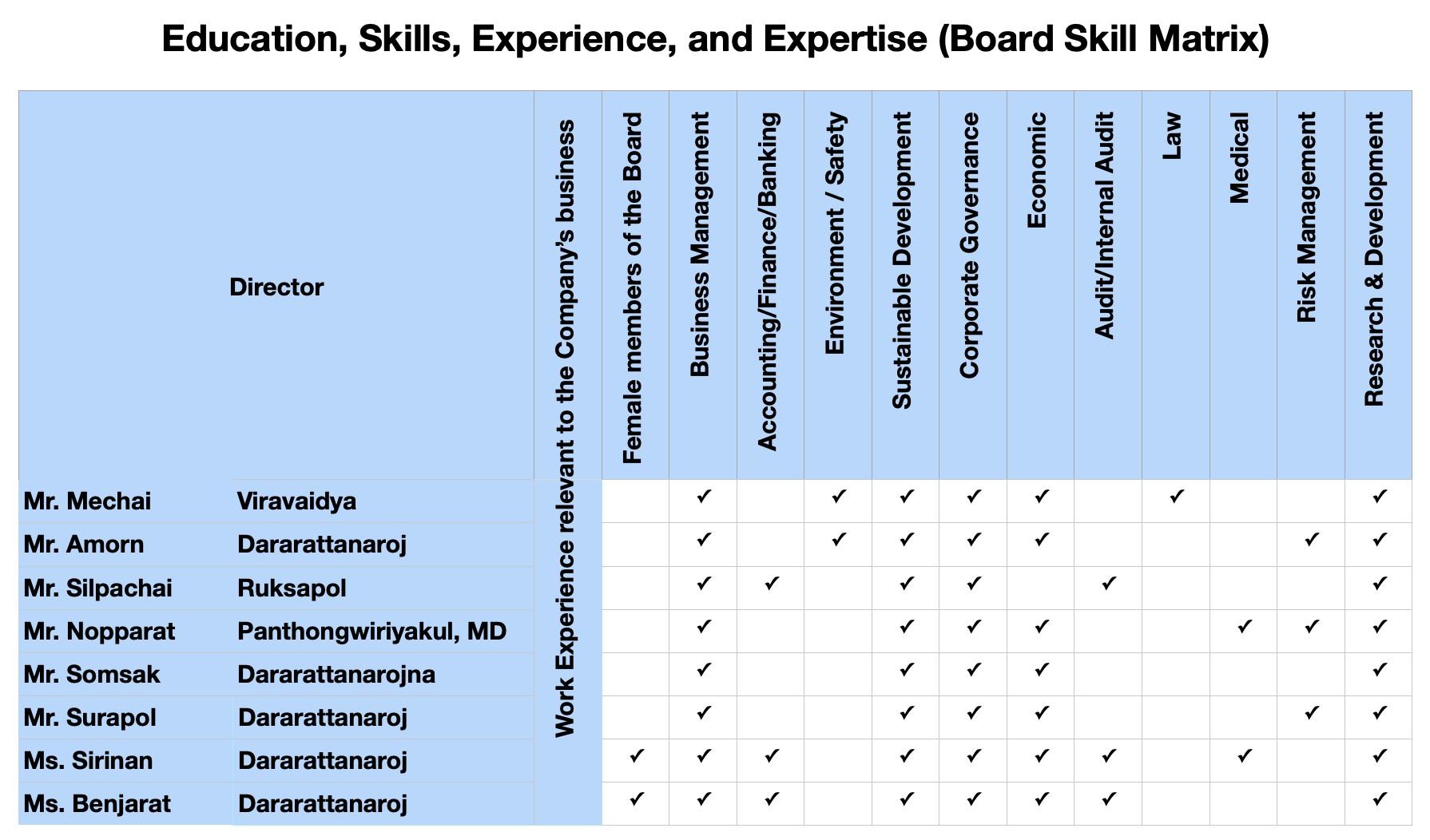
Evaluation of Board & Subcommittee Performance
Criteria for Evaluating Board Performance
Board Performance Evaluation
Criteria
The Company's Board of Directors arranges for an annual performance evaluation of all sub-committees, namely the Audit Committee, the Nomination and Remuneration Committee, and the Executive Committee, at least once a year. This is conducted using the Board's self-assessment guidelines from the Stock Exchange of Thailand, which include topics related to the appropriate structure and qualifications of each sub-committee, sub-committee meetings, and the roles, duties, and responsibilities of each sub-committee. Sufficient importance has been given, and time has been spent on considering, reviewing, and implementing various matters.
Steps
The Company conducts an annual performance evaluation for each sub-committee to assess their operations over the past year. The Company Secretary will send the evaluation form to the Chairman of the Executive Committee to evaluate the performance of each sub-committee. The evaluation results will then be discussed at the Board meeting. The performance evaluation of the sub-committees, which include the Audit Committee, the Nomination, Remuneration and Corporate Governance Committee, and the Risk Management Committee, found that the performance of all sub-committees in 2025 was at a good level.
Evaluation of Board Performance in the Past Year
Evaluation Results
The Board of Directors supports performance evaluations at least once a year, in accordance with good corporate governance principles for listed companies. Topics for discussion are clearly defined before such evaluations are conducted, to gather opinions and present them to the meeting for the Board to review performance, improve and rectify operations, address various problems and obstacles, and incorporate recommendations to collectively enhance the efficiency and effectiveness of the Board's duties. Approval is sought before implementation. Regarding the performance evaluation of the Chief Executive Officer, the concept follows the evaluation model exemplified by the Stock Exchange of Thailand for the CEO for the year 2025. The Chief Executive Officer's performance evaluation results were excellent.
Subcommittees
Subcommittees
| Results of the Subcommittee's Duty Performance |
|---|
Reporting on the performance of duties by the Nomination and Remuneration Committee Dear Shareholders, The Nomination and Remuneration Committee of Thai Nippon Rubber Industry Public Company Limited
with Ms. Supat Kuapradit, Company Secretary and Secretary to the Nomination and Remuneration Committee. In 2025, the Nomination and Remuneration Committee held 2 meetings. The Nomination and Remuneration Committee continuously reported the meeting results and opinions to the Board of Directors for consideration. The key aspects of its performance are as follows: Nominating and selecting individuals for directorship positions Considering and selecting individuals to serve as independent directors, company directors, and sub-committee members to replace directors whose terms have expired. The selection process considers individuals who possess appropriate qualifications, fully comply with the requirements of the Securities and Exchange Commission (SEC) and the Stock Exchange of Thailand (SET), and do not have any prohibited characteristics as stipulated by law. Furthermore, candidates must be knowledgeable, capable, and have transparent work experience, integrity, and responsibility, aligning with the company's business operations. The company also provides an opportunity for shareholders to nominate qualified individuals for consideration as directors before presenting them to the Board of Directors' meeting and the Annual General Meeting of Shareholders for approval. Establishing policies for remuneration and other benefits Establishing remuneration and other benefits for directors and senior executives in a transparent manner, appropriate to their scope of duties and responsibilities, consistent with the company's performance and economic conditions at each period. This also includes benchmarking against policies of other companies of similar size and within the same industry, to ensure that the company's policies are as reasonable and competitive as possible before being presented to the Board of Directors' meeting and the Shareholders' meeting for further approval. Reviewing and revising the charter of the Nomination and Remuneration Committee Reviewing and revising the charter of the Nomination and Remuneration Committee to ensure its suitability. The charter specifies the duties, responsibilities, and scope of work of the Nomination and Remuneration Committee, which aligns with the regulations and guidelines under the Securities and Exchange Act of Thailand. Reviewing and revising the policy, criteria, and methods for nomination and remuneration Reviewing and revising the policy, criteria, and methods for nomination and remuneration to ensure their suitability and up-to-datedness. This policy meticulously specifies the qualifications of directors and senior executives. The Nomination and Remuneration Committee places great importance on individuals with diverse skills, experience, and professional backgrounds, which are essential for the company's business, to ensure the most complete and effective composition of the Board of Directors and the executive team. Based on the aforementioned performance, the Nomination and Remuneration Committee has carried out its assigned duties and continuously reported the meeting results to the Board of Directors. Therefore, in 2025, the Nomination and Remuneration Committee is able to operate fully, with prudence, thoroughness, and independence, as well as providing straightforward opinions for the utmost benefit of shareholders and all stakeholders. Furthermore, it is committed to performing its duties based on principles of equality, fairness, and transparency, in line with the good corporate governance principles stipulated by the Stock Exchange of Thailand. |
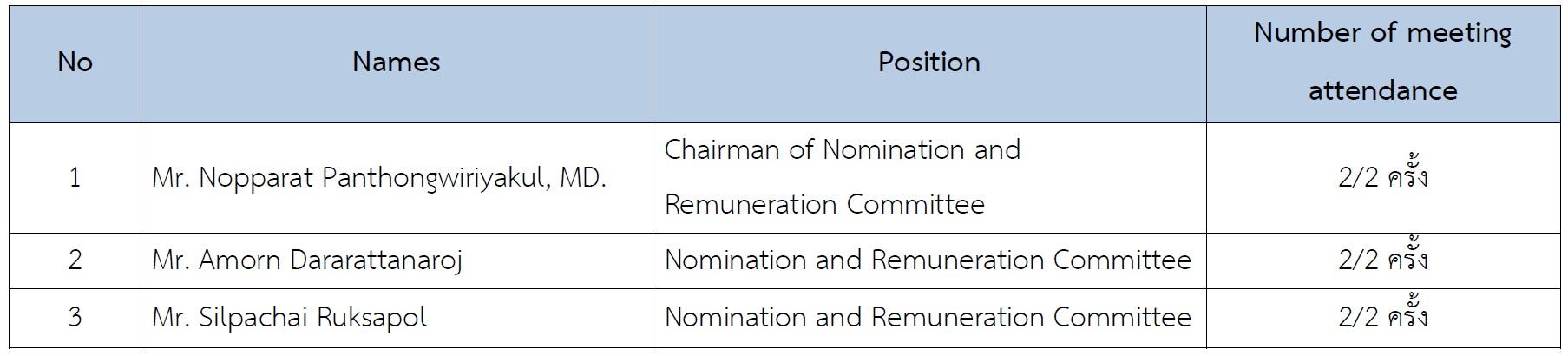
Meeting Attendance & Remuneration
Meeting Attendance — Introduction
In 2025, a total of 4 Board of Directors meetings were held, including one meeting to consider and determine the strategic plan. To encourage non-executive directors/independent directors to freely exchange opinions and suggest various management approaches, one meeting of non-executive directors was also held without management present.
Policy on Remuneration for Directors and Sub-committees
The remuneration of directors shall be within the average range when compared to the same industry, taking into account their experience in performing duties and the responsibilities of the Board of Directors. Executives will receive remuneration in the form of salaries and annual bonuses, primarily based on the company's performance. The total annual remuneration of the Board of Directors and executives combined shall not be unusually high compared to the average remuneration of directors and executives of companies in the same industry, with the utmost benefit to shareholders as the primary consideration.
The Company has established a Nomination and Remuneration Committee to consider and determine the remuneration of directors and the Chief Executive Officer, by setting appropriate and fair remuneration. This will then be proposed to the Board of Directors meeting and/or the Shareholders' meeting for approval (as the case may be).
Types of Remuneration of the Board of Directors
Remuneration Policy for Directors and Sub-Committees
Directors' remuneration must be within the average range compared to the same industry, taking into account the experience, duties, and responsibilities of the Board of Directors. Executives will receive salaries and annual bonuses, primarily based on the company's performance. The total annual remuneration for directors and executives combined must not be unusually high compared to the average remuneration of directors and executives of companies in the same industry, with the primary consideration being the best interests of the shareholders.
The Company has established a Nomination and Remuneration Committee responsible for considering and determining the remuneration of directors and the Chief Executive Officer. The remuneration is set appropriately and fairly and will be proposed to the Board of Directors meeting and/or the Shareholders' Meeting for further approval (as the case may be).
In 2025, at the Annual General Meeting of Shareholders 2025 held on April 10, 2025, the meeting approved the determination of directors' remuneration. The remuneration for the Board of Directors and the Audit Committee was set. For directors' remuneration, the Nomination and Remuneration Committee considered its fairness and reasonableness based on several factors, such as the company's performance, business size, and the duties and responsibilities of the directors, by referencing companies of similar size and in the same industry. For the Audit Committee's remuneration, the Company considered the appropriateness of the remuneration based on their duties, responsibilities, performance, reasonableness, and fairness, as well as to serve as an incentive for directors to build a stable and growing organization. This must be consistent with the company's operating results. The Nomination and Remuneration Committee is responsible for determining the remuneration, bonuses, and evaluating the performance of directors for consideration and approval by the Board of Directors. The resolution from the General Meeting of Shareholders approved directors' remuneration to be paid in the form of quarterly remuneration and meeting allowances, totaling not exceeding 7,000,000 Baht.
Nature of Directors' Remuneration
Monetary Remuneration
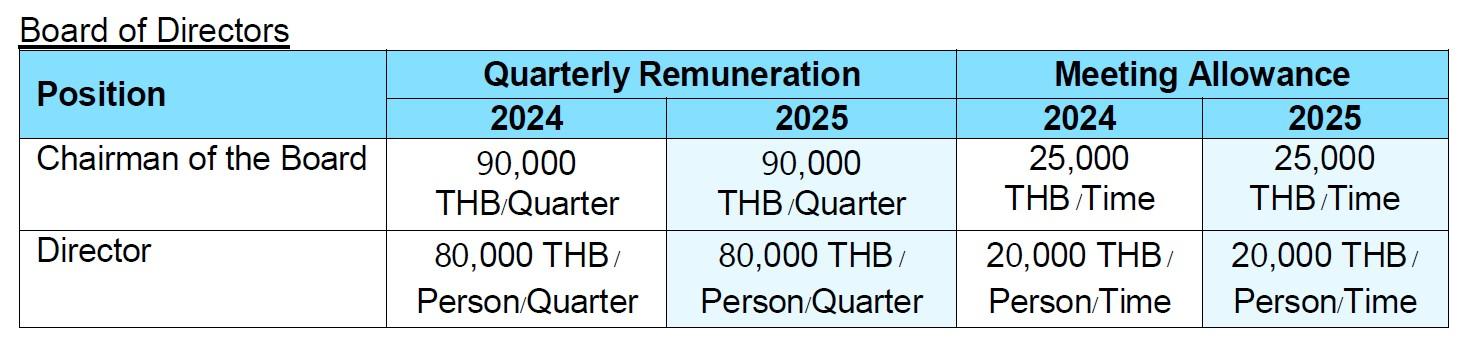
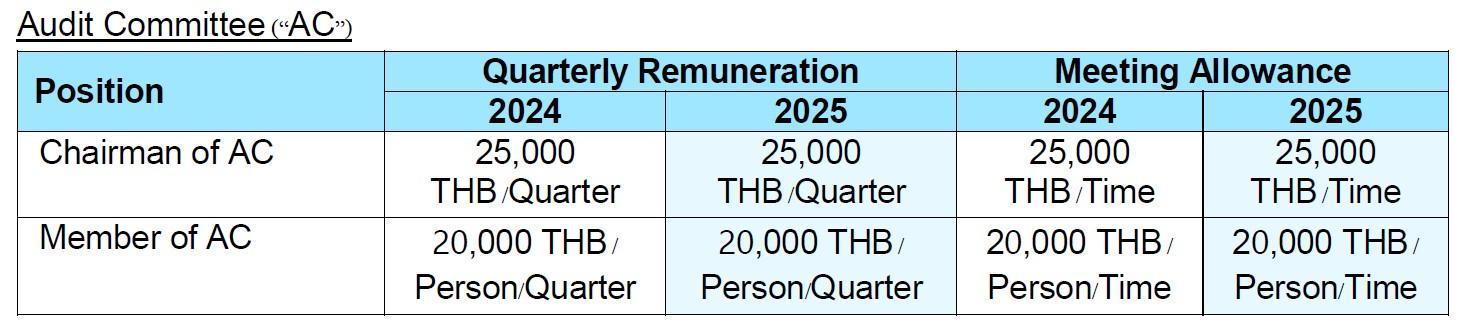
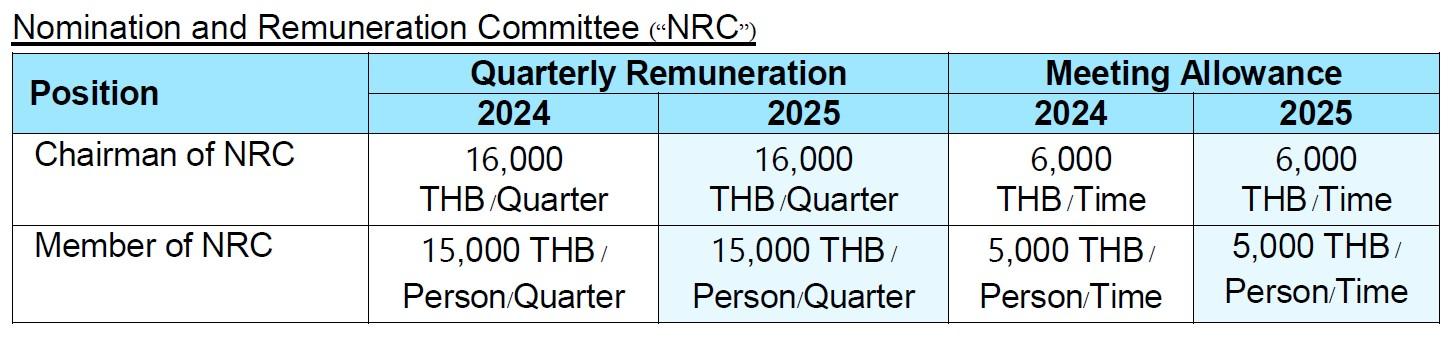
Non-Monetary Remuneration
The Company provides Directors and Officers Liability Insurance for its directors and executives, as well as those of its subsidiaries, with a total liability limit of 300 million Baht per year for both 2024 and 2025. The Company does not provide any other forms of remuneration, welfare, or benefits to its directors beyond the aforementioned remuneration.
Directors' Bonus
As per the resolution of the Annual General Meeting of Shareholders 2025 held on April 10, 2025, company directors are to receive a bonus not exceeding 2.0 percent of the dividends paid to shareholders, for each director, as follows: 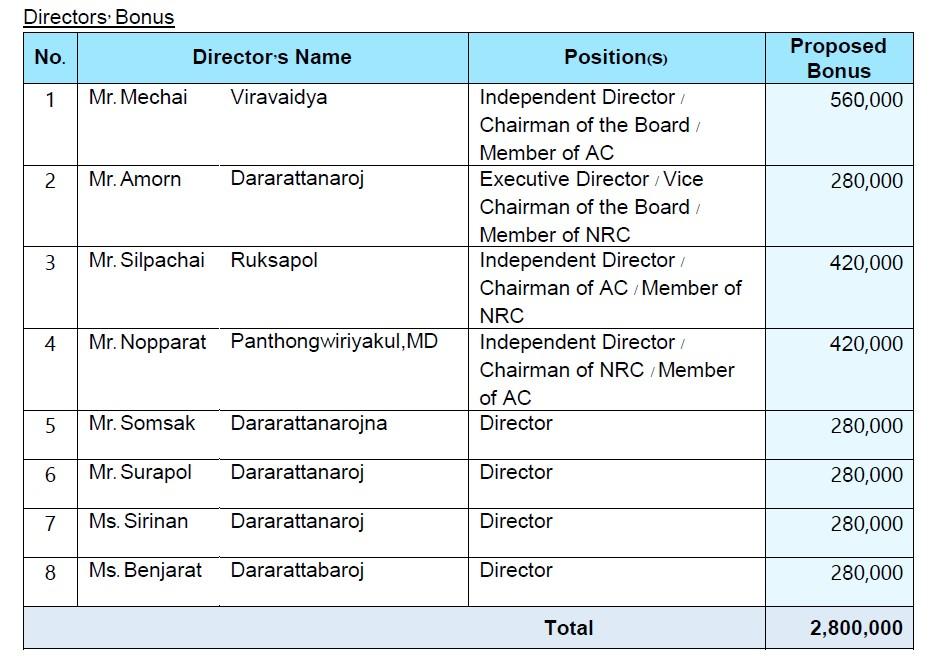
Remuneration or Benefits Payable to the Board
| Metric | Amount (Baht) |
|---|---|
| Remunerations or benefits pending payment to the board of directors over the past year (baht) | 0 |
Supervision of Subsidiaries & Associated Companies
Supervision of Subsidiaries — Introduction
The Company's Investment and Management Policy in Subsidiaries and Associated Companies
The Company has an investment and management policy for subsidiaries and associated companies, whereby it will invest in businesses that are related, similar, or generate benefits and support the Company's operations, in order to enhance the Company's stability and performance. The Company will consider the investment proportion, expected profits, potential risks, and the Company's financial status before deciding to invest in various projects. Such investment approvals must be considered by the Board of Directors' meeting and/or the Shareholders' meeting, according to the defined scope of approval authority.
Furthermore, in supervising the operations of subsidiaries and associated companies, the Company will appoint its representatives, who possess qualifications and experience suitable for the business in which the Company invests, to serve as directors in such subsidiaries and associated companies. Such representatives may include the Chairman of the Board, Chief Executive Officer, directors, senior executives, or any personnel of the Company who do not have conflicts of interest with the business of those subsidiaries and associated companies. This is to enable the Company to control and oversee the business and operations of its subsidiaries and associated companies as if they were integral units of the Company. Therefore, the Company stipulates that its representatives must manage the business of the subsidiaries and associated companies in accordance with the regulations and rules set forth in the articles of association and laws related to the business operations of such subsidiaries and/or associated companies. Moreover, the Company will appoint representatives to serve as directors in such subsidiaries and associated companies in proportion to the Company's shareholding and/or by mutual agreement in the case of associated companies.
The Company will closely monitor the financial performance and operations of its subsidiaries and associated companies, including overseeing the collection of data and accounting records of subsidiaries and associated companies for audit by the Company.
The investment and management policy for the Group's subsidiaries and associated companies has been effective since March 11, 2016, as acknowledged by the resolution of the Board of Directors' meeting on June 28, 2016, onwards. For the year 2025, the Company will continue to adhere to the original policy without any changes.
Does the Company Have Subsidiaries or Associated Companies?
Yes
Is There a Mechanism for Overseeing Subsidiaries and Associated Companies?
Yes
Mechanism for Overseeing Management of Subsidiaries
Governance Mechanism for Subsidiaries and Associated Companies
The Board of Directors oversees the operations of subsidiaries and associated companies as follows:
1. Management is responsible for considering sending company representatives to serve as directors or executives of subsidiaries and associated companies, at least in proportion to the company's shareholding, to represent in setting policies and conducting business in alignment with the company's policies and governance guidelines.
2. Representatives who are directors or executives in subsidiaries and associated companies may perform duties within their scope of authority to protect the company's investment interests, by reporting directly to management. When significant transactions are approved, they must be submitted for approval in accordance with the company's established approval authority regulations.
3. Management is responsible for reporting the operating results of subsidiaries and associated companies to the Board of Directors for periodic acknowledgment, as well as when there are significant operations or changes affecting the company's financial position and operating results.
4. The company's internal auditor is responsible for auditing and reporting the effectiveness of internal controls of subsidiaries to the Audit and Governance Committee periodically, according to the established work plan.
5. The Board of Directors oversees that subsidiaries and associated companies comply with relevant laws and regulations, including the disclosure of financial status and operating results, transactions with related parties, the acquisition or disposal of assets, as well as other significant transactions, fully and accurately, in accordance with the same criteria as the company.
Oversight Mechanisms
| Mechanism |
|---|
| Sending representatives to act as directors, executives or controlling persons in proportion to shareholdings |
| Defining the scope of powers, duties and responsibilities of directors and executives who represent the company in setting important policies |
| Disclosure of financial information and operating results |
| Transactions between the Company and related persons |
| Other important transactions |
| Acquisition or disposal of assets |
| Internal control system of the subsidiary operating the core business is appropriate and sufficient in the subsidiary operating the core business |
Board Duty Performance — Overview
Board Duty Performance — Overall Description
Board meetings are scheduled to be held at least four times a year. Each director and the entire Board are required to attend at least 75% of the total meetings for the year. Official Board meeting dates are set at least one year in advance, with the Company Secretary notifying the exact Board meeting dates one year in advance, specifically by December of the preceding year, and formally announcing them at the first Board meeting of that year, to enable directors to allocate their time for meetings throughout the year. However, additional meetings may be called for special or urgent matters. In the past year, a total of four Board meetings were held, which is appropriate for the duties and responsibilities of the Board and the Company's business operations. All committees' directors attended 99.81% of the meetings. Additionally, one Audit Committee meeting was held with external auditors, without management and internal auditors present, on December 4, 2568.
Summary of the Board of Directors' Performance
The Board of Directors, as representatives of the shareholders, is responsible for overseeing the Company's management to ensure compliance with laws, announcements, regulations, rules, and other relevant laws, as well as with the Company's objectives and articles of association. The Board also ensures that management operates under corporate governance policies and is socially responsible to promote confidence among shareholders, the public, and all stakeholder groups. The Board of Directors stipulates that meetings be held at least once every three months and may call additional meetings as deemed appropriate, as outlined in the Board Charter. Meeting dates and times are set in advance for the entire year, and directors are informed of the meeting schedule. For Board meeting agendas, each director may propose agenda items. The Chairman of the Board and the Managing Director will jointly consider matters to be presented at the meeting. Subsequently, the Company Secretary sends out meeting invitations and agendas, along with supporting documents, at least 7 days in advance to allow each director sufficient time to review and study the information before attending the meeting. In the past year, the Board of Directors held a total of 4 meetings, with all directors attending every meeting, representing 100%. Details are as follows:
Board of Directors Meeting No. 1/2568 on February 27, 2568
Board of Directors Meeting No. 2/2568 on May 14, 2568
Board of Directors Meeting No. 3/2568 on August 14, 2568
Board of Directors Meeting No. 4/2568 on November 12, 2568
The number of Audit Committee meetings attended is as follows:
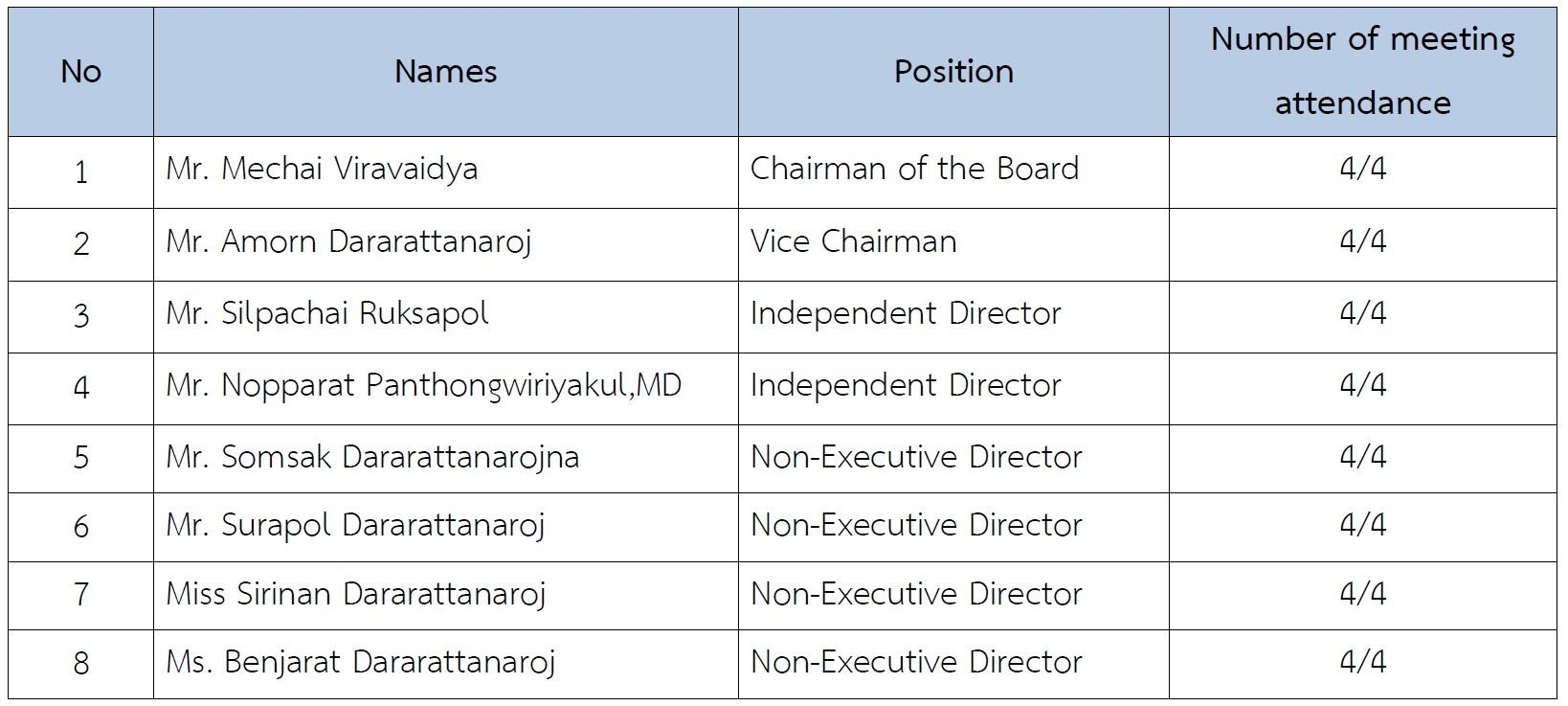
The Board of Directors has participated in defining the Company's vision, policies, goals, business plans, and budgets, with a strong emphasis on ethics and stakeholder impact, in addition to financial performance. These are reviewed and approved every quarter and fiscal year. The Board also oversees management to ensure operations align with the established strategic plans and budgets efficiently and effectively. Performance reports are provided by the Executive Committee every quarter. The good corporate governance policy and business ethics manual, as well as various Company policies, are reviewed and integrated into the Company's culture. The Board of Directors sets an example by adhering to these policies and manuals, communicating and requiring all directors, executives, and employees to follow them, and regularly monitoring compliance to ensure business operations are transparent, efficient, and auditable.
The Board of Directors recognizes the importance of internal control systems, internal audit, and risk management. Therefore, the Board has reviewed and ensured that the Company has an effective internal control system, consistent with the acceptable risk level, and has assigned the Audit Committee to regularly review and monitor the results of internal controls. The Audit Committee reports to the Board every quarter to build confidence among executives, investors, and all stakeholders. The Board of Directors has considered and found that the Company's internal control system is adequate and appropriate.
The Board of Directors has emphasized promoting and supporting the adoption of innovation and technology to enhance the Company's competitiveness and create value in response to changing circumstances, as well as to increase operational efficiency, all for the benefit of all stakeholders. The Board of Directors has assigned the management to incorporate this into strategy reviews, operational development and improvement planning, and continuous monitoring of operational results. The Board plays a role in supporting the Company to operate sustainably, pushing for the establishment, review, and adherence to policies, strategies, operational plans, and goals for sustainable development within the organization, to create a balance between business operations, environmental care, and fostering well-being for society, communities, and employees. Furthermore, as the Company is a hirer of construction contractors, the Board of Directors has stressed the importance of occupational health and safety from work processes that may affect
impact on communities and relevant parties regarding dust, noise pollution, water pollution, vibration of the project area during construction, as well as traffic impacts around the construction site, arising from construction processes that affect communities in all projects, to prevent adverse effects on communities and areas surrounding the ongoing construction projects. This includes considering good hygiene for workers and residents in nearby communities. The Board of Directors has performed its duties and responsibilities in managing the Company and its subsidiaries in accordance with the law, objectives, and articles of association of the Company and its subsidiaries, as well as legally valid resolutions of shareholders' meetings, with honesty, integrity, and diligence in safeguarding the interests of
the Company and all shareholders equally.
Sub-section Introduction
The Board of Directors plays a crucial role in setting the company's policies, in collaboration with the Executive Committee and senior management. It also oversees to ensure compliance with the company's primary objectives and goals, values, organizational culture, vision, mission, financial policies, risk management, strategies, operational plans, and the company's annual budget. Furthermore, it oversees to ensure that the formulation of annual strategies and plans aligns with the company's primary objectives and goals, and analyzes opportunities that may impact business operations, thereby building trust among shareholders, investors, and stakeholders. In formulating annual strategies and plans, an analysis of the environment, challenges, and opportunities affecting business operations, enhancing competitiveness, and overseeing the adequacy of internal control systems is conducted to develop key strategies that the organization prioritizes. An environmental analysis is also conducted.
Audit Committee Duty Performance
Results of the Audit Committee's Duty Performance in the Past Year
Audit Committee Performance Report for 2025
Dear Shareholders,
The Audit Committee of Thai Nippon Rubber Industry Public Company Limited (" The Company ”) consists of 3 independent directors, with Mr. Silchai Raksapol serving as Chairman of the Audit Committee, and Mr. Meechai Viravaidya and Dr. Nopparat Panthongwiriyakul as Audit Committee members. All members are independent, not involved in the Company's management, and fully qualified. The Audit Committee has performed its duties as assigned by the Board of Directors and within the scope of responsibilities specified in the Charter approved by the Board of Directors, which aligns with international principles and best practices of the Securities and Exchange Commission and the Stock Exchange of Thailand. Its scope includes reviewing financial reports, internal audit reports and internal control systems, connected transactions or transactions that may have conflicts of interest, and proposing the appointment and remuneration of auditors. The objective is to focus on being a transparent company with adequate, efficient, and effective internal control systems, capable of creating sustainable value and a positive image for the Company. Ms. Supat Kuanpradit serves as the Secretary to the Audit Committee.
In 2025, the Audit Committee held joint meetings with the external auditor, PricewaterhouseCoopers ABAS Ltd. (PwC), management, and Thammaniti Internal Audit Co., Ltd. (" Internal Audit Service Provider Company ”) which convened on various topics under the duties of the Audit Committee as stipulated in the Audit Committee Charter, such as the accuracy and completeness of financial reports, the effectiveness of internal control systems, the consideration of connected transactions or transactions that may have conflicts of interest, the appointment of auditors, as well as the consideration of compliance with relevant laws and regulations, to cover the operations of the Company and its subsidiaries ("the Group"). A total of 5 meetings were held as follows:
Audit Committee Meeting No. 1/2025 on February 27, 2025
Audit Committee Meeting No. 2/2025 on May 14, 2025
Audit Committee Meeting No. 3/2025 on August 14, 2025
Audit Committee Meeting No. 4/2025 on November 12, 2025
Audit Committee Meeting with External Auditors (without management) and Audit Committee Meeting with Internal Auditors (without management) on December 4, 2025
The number of Audit Committee meetings attended is as follows:

The objectives of the Audit Committee meetings are to review the accuracy and adequacy of the Company's financial reports, review the adequacy and effectiveness of internal control systems, consider connected transactions, review compliance with relevant laws and regulations of the Company and its affiliates, review amendments to the Audit Committee Charter and internal audit policies, and select auditors. The primary duties and responsibilities of the Audit Committee are to support the Board of Directors in its oversight functions regarding the preparation and disclosure of financial report information, the effectiveness of risk management and internal control systems, compliance with relevant laws, regulations, and rules, including promoting risk management and internal control according to the Three Lines of Defense approach. This approach focuses on ensuring that the first line of defense (units directly facing risks) understands and manages their work in accordance with established rules and risk management. The Corporate Risk Management Department is responsible for the second line of defense, setting the overall risk management framework and assisting the first line in managing identified risks. The internal audit unit, an external internal audit service provider, is responsible for the third line of defense, providing independent assurance and assessing the effectiveness of risk management and internal controls. Additionally, the Audit Committee is responsible for monitoring the qualifications, expertise, team adequacy, and independence of both the internal audit service provider and the Company's auditors, including the selection, removal, and change of internal audit service providers, and evaluating the effectiveness of their performance. The Audit Committee regularly reports its performance and recommendations to the Board of Directors. Whenever the Audit Committee has doubts or believes that corrective or improvement actions should be taken regarding risk management and internal controls, financial reports, or other matters discovered during audits, the Audit Committee will promptly report such doubts or recommendations to the Board of Directors. The key duties of the Audit Committee can be summarized as follows:
1. Review of Financial Reports
The Audit Committee reviewed the Company's annual financial statements and considered consolidated and separate financial information both quarterly and for the fiscal year 2025 for the Group and for separate entities, including intercompany transactions and transactions that may have conflicts of interest, in conjunction with management and external professional internal auditors. Auditors were invited to participate in meetings to consider these financial reports. Inquiries were made to the auditors regarding the accuracy and completeness of the financial statements, adjustments to material accounting items affecting the financial statements, the scope of the audit, the adequacy of documentation, evidence, and internal control systems, the appropriateness of accounting methods, compliance with financial reporting standards, the adequacy, accuracy, and completeness of disclosures, and the independence of the auditors. This was to ensure that the preparation of financial statements complies with legal requirements and accounting standards under generally accepted accounting principles, is reliable and timely, and includes sufficient disclosure beneficial to financial statement users.
The Audit Committee held one meeting with the auditors, without management present, to discuss the audit plan, the independence of their duties, and the auditors' opinions. Emphasis was placed on presenting additional information in the auditors' report according to new standards (Key Audit Matters: KAMs), as well as suspicious circumstances under Section 89/25 of the Securities and Exchange Act B.E. 2535, as amended by the Securities and Exchange Act (No. 4) B.E. 2551. In 2025, the auditors did not raise any material observations and found no such suspicious circumstances. Therefore, the Audit Committee is of the opinion that the Company has an appropriate financial reporting system for disclosing financial information free from material misstatements and prepared in accordance with financial reporting standards.
2. Review of Risk Management System
The Audit Committee reviewed the efficiency and effectiveness of risk assessment and risk management systems, as well as risk management plans affecting the Company. This involved regular meetings and discussions with management to oversee the plans. The Company's enterprise risk management framework was established, risks were reviewed, and the implementation of risk mitigation plans was monitored, along with providing recommendations for further improvement.
3. Oversight of Internal Audit Work
The Audit Committee engaged Thammaniti Internal Audit Co., Ltd. (" Internal Audit Service Provider Company ”) which is an external company providing internal audit services, to serve as the internal auditor for the Group for the year 2025. To ensure the independence of the internal audit, the Audit Committee reviewed internal audit reports and operational progress quarterly according to the approved internal audit plan, providing recommendations and observations for efficient and effective operations. The implementation of recommendations and observations to address significant issues was continuously monitored, aiming for resource utilization, asset protection, prevention or reduction of errors, damages, leakages, waste, or fraud, reliability of financial statements, compliance with laws, regulations, and rules, as well as tracking progress in correcting or improving internal control systems. This ensures that the Group's units have appropriate internal control systems consistent with current operations, future business goals, and plans. The auditors concurred that no material internal control deficiencies affecting the Company's financial statements were found. Therefore, the Audit Committee is of the opinion that the Company has appropriate and adequate internal control systems and no material internal control deficiencies were found.
4. Review of Good Corporate Governance Processes
The Audit Committee supported good corporate governance and considered complaints regarding corruption, such as providing channels for employees, shareholders, and external parties to directly contact the Audit Committee through a whistleblowing system to report information related to complaints.
illegal acts or breaches of business ethics, corruption, inquiries regarding financial reports, as well as systems.
the Company's internal controls. The Company has protective measures in place to keep the identity of whistleblowers confidential. In 2025, there were no complaints regarding misconduct or corruption.
Additionally, the Committee considered and acknowledged the certification of employees' compliance with business ethics, submitted to their supervisors up to the Chief Executive Officer. The process and content of this certification ensure that the Company oversees its operations in accordance with good corporate governance processes, business ethics, and relevant laws.
5. Compliance with Laws, Rules, Regulations, and By-laws
In 2025, the Audit Committee reviewed and monitored the operations of the Group, focusing on management policies to ensure systematic good corporate governance. It supported the preparation of financial reports, both financial and non-financial, as well as reviewing connected transactions or transactions that may have conflicts of interest to ensure that such transactions are transparent, reasonable, fair, free from material conflicts of interest, and generate maximum benefit for the Company, in compliance with the laws, rules, regulations, and by-laws of the Securities and Exchange Commission, the Stock Exchange of Thailand, and other regulatory bodies, including any other laws or requirements related to the Group's business operations. The Audit Committee is of the opinion that the Company has complied with the applicable laws, regulations, and rules governing its operations in accordance with key legislation.
6. Consideration of Auditor Appointment and Remuneration
The Audit Committee assessed the appropriateness of the scope of work, transparency, and efficiency of the auditors' performance, as well as the reasonableness of audit fees, including their knowledge, competence, experience, and credibility, and an evaluation of their independence. This assessment covered various aspects such as the overall quality of the audit, the time spent providing advice on problem-solving, the quality of the team in terms of knowledge, competence, and experience in the Company's core business, and adherence to the planned work.
After careful consideration, the Audit Committee and the Board of Directors agreed to propose to the Annual General Meeting of Shareholders for 2025 the appointment of PricewaterhouseCoopers ABAS Ltd. as the auditor for the Group for the year 2025, and to appoint Ms. Amornrat Permpoonwattanasuk, Certified Public Accountant Registration No. 4599 (never signed), and/or Mr. Boonruang Lertwisetwit, Certified Public Accountant Registration No. 6552 (never signed), and/or Mr. Karn Tanthawirat, Certified Public Accountant Registration No. 10456 (never signed), from PricewaterhouseCoopers ABAS Ltd. as the Company's auditors, including considering the audit fee for 2025 in the amount of 2,950,000 Baht, excluding other expenses. This proposal has been submitted to the Board of Directors for presentation and approval at the Annual General Meeting of Shareholders for 2025.
7. Connected Transactions or Transactions That May Have Conflicts of Interest
The Audit Committee considered the disclosure of information by the Group in cases of connected transactions or transactions that may have conflicts of interest, ensuring their accuracy and completeness. The Committee is of the opinion that the Group's information disclosure is adequate and in compliance with the criteria of the Stock Exchange of Thailand and the Securities and Exchange Commission.
8. Review of the Audit Committee Charter, Company Policies, Good Corporate Governance Principles, and Business Ethics
The Audit Committee annually reviewed the appropriateness of the Audit Committee Charter, various company policies, good corporate governance principles, and business ethics, ensuring compliance with practices and regulations of the Securities and Exchange Commission of Thailand and the Capital Market Supervisory Board.
9. Assessment of the Audit Committee's Performance
The Audit Committee conducted a performance evaluation of the Audit Committee, both collectively and individually, in accordance with the Audit Committee Charter approved by the Board of Directors, relevant regulations, and assignments from the Board of Directors. The performance evaluation was conducted according to the criteria and assessment form from the Securities and Exchange Commission, and the results indicate that the Audit Committee performed its duties excellently.
In summary, the Audit Committee has performed its duties and responsibilities as stipulated in its Charter, exercising its knowledge, competence, diligence, prudence, and sufficient independence. It has also provided various opinions and recommendations for the equal benefit of all stakeholders. The Audit Committee is of the opinion that the Company's financial information reports are accurate, reliable, and in accordance with generally accepted accounting standards. The Company
operates in compliance with relevant laws and regulations, has adequate risk management, and appropriate and effective internal control and internal audit systems. Based on the quarterly financial information review reports and the annual financial statement audit report for 2025, and the assessments by the auditors and the aforementioned internal audit service provider, the Audit Committee found no indications of practices that do not comply with financial reporting standards, requirements under the Securities and Exchange Act, and the rules and regulations of the Stock Exchange of Thailand.
Executive Committee Duty Performance
Results of the Executive Committee's Duty Performance in the Past Year
Dear Shareholders,
The Executive Committee of Thai Nippon Rubber Industry Public Company Limited (“ The Company ”) comprises all directors, with Mr. Amorn Dararattanaroj as the Chairman of the Executive Committee, Miss Sirinan Dararattanaroj,
The Executive Committee of Thai Nippon Rubber Industry Public Company Limited consists of 6 directors, namely:
with Miss Supat Kuanpradit as the Company Secretary and the Executive Committee. In 2025, the Executive Committee held 12 meetings, and the Executive Committee continuously reported the meeting results along with their opinions to the Company's Board of Directors for consideration. The scope of duties is as follows:
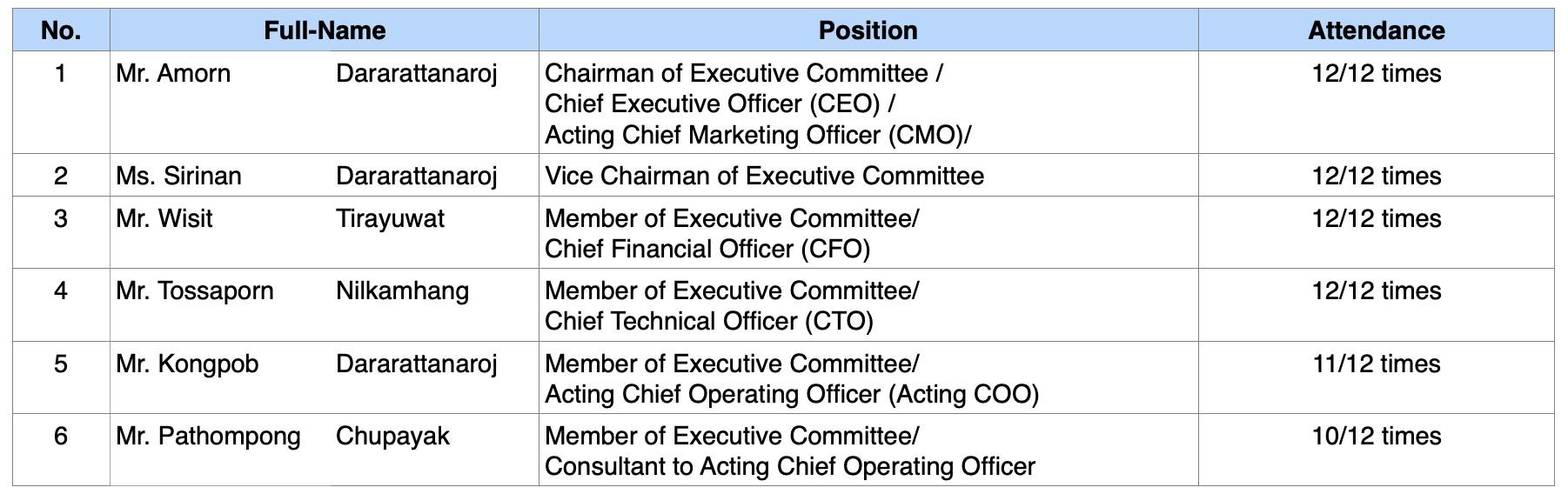
1. Formulate and establish policies, directions, strategies, business plans, budgets, organizational structures, and management authority for submission to the Company's Board of Directors for approval, and implement them as approved by the Company's Board of Directors, including monitoring and evaluating the performance to ensure efficiency and effectiveness. In 2025, the Board reviewed the Company's vision/mission/strategy.
2. Manage and oversee operations related to the normal course of business.
3. Approve the execution of any contracts and/or transactions related to the Company's normal course of business (e.g., buying and selling, investments, or joint ventures with other parties for the Company's ordinary transactions and for the benefit of operating in accordance with the Company's objectives) within the limits specified in the approval authority or as determined by the Board of Directors.
4. Approve any borrowing and credit applications from financial institutions, lending, as well as pledging, mortgaging, or acting as a guarantor for the Company and its subsidiaries within the limits specified in the approval authority or as determined by the Board of Directors.
5. Approve the appointment of various consultants necessary for the Company's operations, within the approved budget framework by the Company's Board of Directors each year.
6. Establish frameworks and policies for determining salaries, salary increases, bonus payments, compensation, and employee benefits.
7. Perform any other duties as assigned by the Board of Directors or as stipulated by the Company's Board of Directors.
8. Delegate authority to one or more individuals to perform any action on behalf of the Executive Committee.
However, the delegation of duties and responsibilities by the Executive Committee shall not constitute a delegation of authority or sub-delegation that would allow the Executive Committee or its delegates to approve transactions in which they or any potentially conflicted persons (as defined in the notifications of the Securities and Exchange Commission or the Capital Market Supervisory Board) may have an interest, receive any benefit, or have any other conflict of interest with the Company or its subsidiaries, except for approvals of transactions that comply with the policies and criteria approved by the Company's Board of Directors meeting.
Based on the aforementioned performance, the Executive Committee has carried out its assigned duties and continuously reported the meeting results to the Company's Board of Directors. Therefore, in 2025, the Executive Committee was able to operate fully with prudence, circumspection, and independence, as well as provide candid opinions for the utmost benefit of shareholders and all stakeholders. Furthermore, it is committed to performing its duties based on principles of equality, fairness, and transparency, in line with the principles of good corporate governance as prescribed by the Stock Exchange of Thailand.